AWS completed its acquisition of DuckLabs on August 31, 2026, one day before the Amsterdam team behind DuckDB officially joined the company. Most of the coverage since has landed on the same headline: a hyperscaler just validated lightweight, in-process analytics. That's true, and it's the smaller story. The larger one is what AWS chose not to do. It didn't fold DuckDB's execution model into Redshift or rebuild a faster Athena. It bought a second execution engine and said, in its own words, that it plans to run it alongside the first one. A cloud provider with every incentive to sell one unified stack just admitted, in public, that no single engine covers every workload well — not even one it built itself.
DuckDB itself isn't changing hands. The open-source project stays under the independent DuckDB Foundation, distributed under the MIT license exactly as before; AWS acquired the company and its engineering talent, not the code's ownership.[1] Founders Hannes Mühleisen and Mark Raasveldt keep steering the technical roadmap, now as AWS employees, working from Amsterdam.[1]
What matters for anyone building or buying a data pipeline isn't the acquisition itself. It's the segmentation logic AWS used to justify it, and what that logic implies for teams that don't have the option of keeping everything inside one cloud account.
What AWS Actually Bought
Start with what the deal does not include. DuckDB is an in-process analytical database: it runs embedded inside whatever application calls it, with no separate server to install or administer, and it executes SQL directly against files such as Parquet, CSV, and JSON rather than requiring the data to be loaded into a proprietary store first.[2] Since its 1.0 release in 2024, it built a following among developers who wanted warehouse-grade analytical performance on a laptop, or against object storage, without provisioning a cluster to get it.[2]
DuckLabs, the Amsterdam company Mühleisen and Raasveldt co-founded, was bootstrapped and owned by its founders and developers, and it had turned down venture capital.[9] AWS's transaction brings that company and a team of more than thirty engineers into AWS.[9] It does not touch the DuckDB Foundation, the nonprofit that holds the open-source project's intellectual property, and it does not change the MIT license anyone already building on DuckDB relies on.[1]
The two-layer structure. DuckLabs, the company, built and maintained DuckDB and is now part of AWS. The DuckDB Foundation, an independent nonprofit, owns the open-source project's intellectual property and governs its direction. AWS acquired the first. It did not acquire the second.
That distinction shaped a lot of the early reaction. On Hacker News, where the story became one of the most-discussed technology threads of the week, much of the debate wasn't about the deal's terms. It was about whether a foundation-governed license structure actually protects a project once most of the people who write its code report to the company that just bought their employer.[4] That's a fair question, and one worth returning to. It isn't, however, the most consequential part of the announcement.
Why AWS Bought a Second Engine Instead of Building One
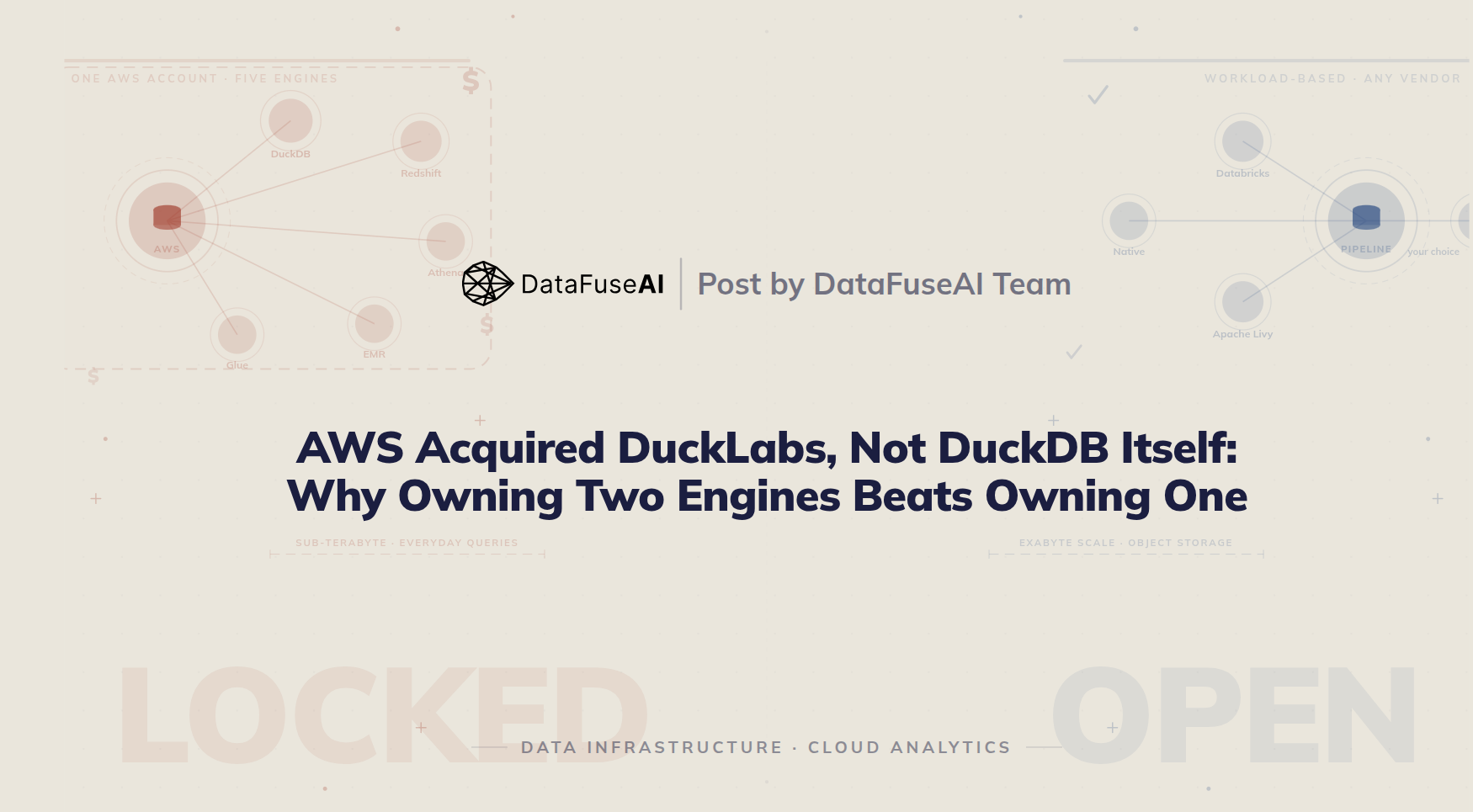
AWS already owns Redshift for warehouse analytics, Athena for serverless SQL over S3, EMR for distributed Spark workloads, and Glue for ETL orchestration. A company with that portfolio has every reason to fold a promising open-source engine into whichever product it competes with most directly, then let the acquisition fade into a changelog entry. AWS said, plainly, that this is not the plan.
In its own announcement, AWS described the intent as combining DuckDB's speed at what it called "everyday queries of a terabyte or less" with the exabyte-scale reach of S3 and its existing analytics services, including Redshift, Athena, EMR, Glue, and SageMaker.[1] That isn't a replacement plan. It's a segmentation plan: small, fast, exploratory queries go one way; distributed, large-scale processing goes another; and AWS now owns both paths instead of one.
AWS's own framing treats DuckDB and its distributed-scale engines as two answers to two different workload shapes, not one engine competing to replace the other.
Distinguished engineer Andy Warfield laid out the underlying reasoning in a companion post on AWS's engineering blog. Referencing the project's own academic paper on its design, he noted that its authors built DuckDB largely by combining established, well-understood techniques rather than inventing something new, and argued that the more interesting shift isn't the engine itself so much as recognizing how much real-world analytical work never needed distributed infrastructure in the first place.[6] Older engines built for scale, in other words, were never designed to scale down gracefully. DuckDB was built to do exactly that, and AWS decided it was worth owning rather than approximating.
This isn't a pattern unique to AWS. OpenAI acquired Rockset, a real-time analytics and search database, in 2024, reportedly in a stock deal worth several hundred million dollars, specifically to power retrieval infrastructure behind its own products rather than build an equivalent internally.[7] Databricks paid roughly a billion dollars for Neon, a serverless Postgres company, in 2025, on top of earlier acquisitions of Tabular and MosaicML — each one a specialized data engine bolted onto a platform that could, in theory, have tried to replicate the capability with tools it already had.[8] None of these companies concluded that one engine, however well-funded, covers every workload shape. Each concluded it was faster and cheaper to buy the second engine than to build a worse version of it.
The Counterargument: Isn't This Just Deeper Lock-In?
Some of the sharpest skepticism about the deal came from people who use DuckDB daily. A recurring thread on Hacker News argued that Amazon has a documented pattern of acquiring or absorbing technically interesting projects and then deprioritizing them once internal incentives shift, and that a nonprofit foundation holding the IP doesn't fully settle the question of who actually writes the code and who they answer to. Others asked a more basic question: if AWS already has Redshift, Athena, EMR, and Glue, what exactly does it get from this that it didn't already have?[4]
Both objections deserve a straight answer rather than a dismissal. On the second question, one response to that skepticism holds up well: once DuckDB queries run against data sitting in S3, that usage shows up as billable AWS compute. Keeping the project fast and widely used is now something AWS profits from directly, not just something it hopes will pay off eventually.[5] That's true, and it's exactly the point worth sitting with. The incentive that makes this a reasonable bet for AWS is the same incentive that should make any non-AWS team pause before building critical pipeline infrastructure entirely around it.
If you already run on AWS, this deal genuinely does deepen how much of your analytical workload gravitates toward Amazon's account and billing surface: DuckDB against S3, orchestrated by Glue, escalated to EMR or Redshift at scale. That's not a hidden agenda. AWS said as much itself. For AWS customers who've already made their platform bet, this is a reasonable, well-signaled extension of it.
AWS choosing between DuckDB, Redshift, Athena, EMR, and Glue for you still means every option bills to the same account, runs on the same infrastructure, and reinforces the same platform commitment. Engine choice without vendor choice.
Choosing an execution engine by workload shape, independent of which cloud or platform vendor built it, keeps pipeline design portable even when the underlying compute target changes.
The Practitioner's Version of the Same Bet
Strip away the brand names and AWS's logic reduces to something simpler: match the engine to the workload instead of forcing every workload through the one engine you already paid for. That principle doesn't require being a hyperscaler to apply. It requires treating pipeline design and execution engine as two separate decisions instead of one bundled purchase.
DataFuseAI has approached compute-engine choice this way since before this acquisition made it a headline: pipelines run against Databricks, Apache Livy, or DataFuseAI's own native engine, selected per workload rather than locked to a single path. The AWS-DuckLabs deal is a useful, concrete argument for extending that same segmentation logic further down toward lightweight, sub-terabyte workloads: local files, direct queries against Parquet in object storage, profiling and validation passes that don't need a distributed cluster spun up to answer a small question. That's an architectural direction worth evaluating carefully, not a capability to announce ahead of the engineering work. A segmentation strategy is only as good as the boundary conditions it actually handles, and those need testing before they're worth a customer's trust.
None of this requires betting against distributed compute. Terabyte-and-up transformations, heavy shuffle operations, and production-scale joins still belong on Databricks or Spark, on AWS or anywhere else. The point isn't that lightweight engines replace distributed ones. It's that the choice between them should sit with the team designing the pipeline, not with whichever vendor happens to own the account it runs in. That's the same argument behind treating vendor lock-in as an infrastructure risk worth designing around directly, and it's why compute engine flexibility matters independent of which specific engines end up on the list.
The AI-agent angle AWS emphasized is real, if narrower than the framing suggests. Warfield's post describes agents exploring data in small, iterative steps rather than running one large scheduled job, a pattern that favors an engine with low startup overhead over one that requires provisioning a cluster to answer a single exploratory question.[6] That's a legitimate reason a lightweight embedded engine matters for agentic workloads specifically, and it connects to a question pipeline teams are already asking: what AI models actually need from a data pipeline in the first place. It isn't, on its own, a reason to treat any single execution engine as a universal answer. The same caution that applies to zero-ETL's own unstated limitations applies here too.
What to Watch Next
A few concrete developments will show whether this bet plays out the way AWS is framing it. DuckLabs had already signaled a shift in direction nine days before the acquisition became public, previewing DuckDB 2.0, due this fall, and describing the release as the start of DuckDB operating as a server rather than staying strictly embedded, enabled by a new component called Quack that lets one DuckDB instance serve data to others over a network.[3] That shift, if it ships as described, changes DuckDB's competitive position: a server-capable DuckDB competes in more places than a purely embedded one did.
DuckLabs has also said it plans to stand up a technical advisory board under the DuckDB Foundation this fall, giving outside contributors and major users a formal channel into the roadmap, and it intends to open the project's extension system to signed third-party extensions rather than keeping it limited to DuckLabs-maintained ones.[9] Both are governance signals worth watching before drawing firm conclusions about neutrality. They're commitments, not yet outcomes, and the difference matters for anyone deciding how much architecture to build around them.
None of this needs to be resolved before a team decides how to think about execution engines going forward. The segmentation logic AWS used to justify this deal doesn't depend on how DuckDB's governance plays out over the next year. It depends on something more durable: that workload shape, not vendor allegiance, should decide which engine runs a given piece of a pipeline.
AWS just spent real money to avoid making that decision on your behalf inside its own products. That's worth noticing regardless of which cloud a given team runs on. The industry's largest infrastructure vendor looked at its own stack and concluded that owning one exceptionally good engine wasn't the same as owning the right answer for every workload. Teams that don't have AWS's balance sheet can reach the same conclusion for a fraction of the cost, simply by refusing to let one engine, or one vendor's roster of engines, make that decision by default.