

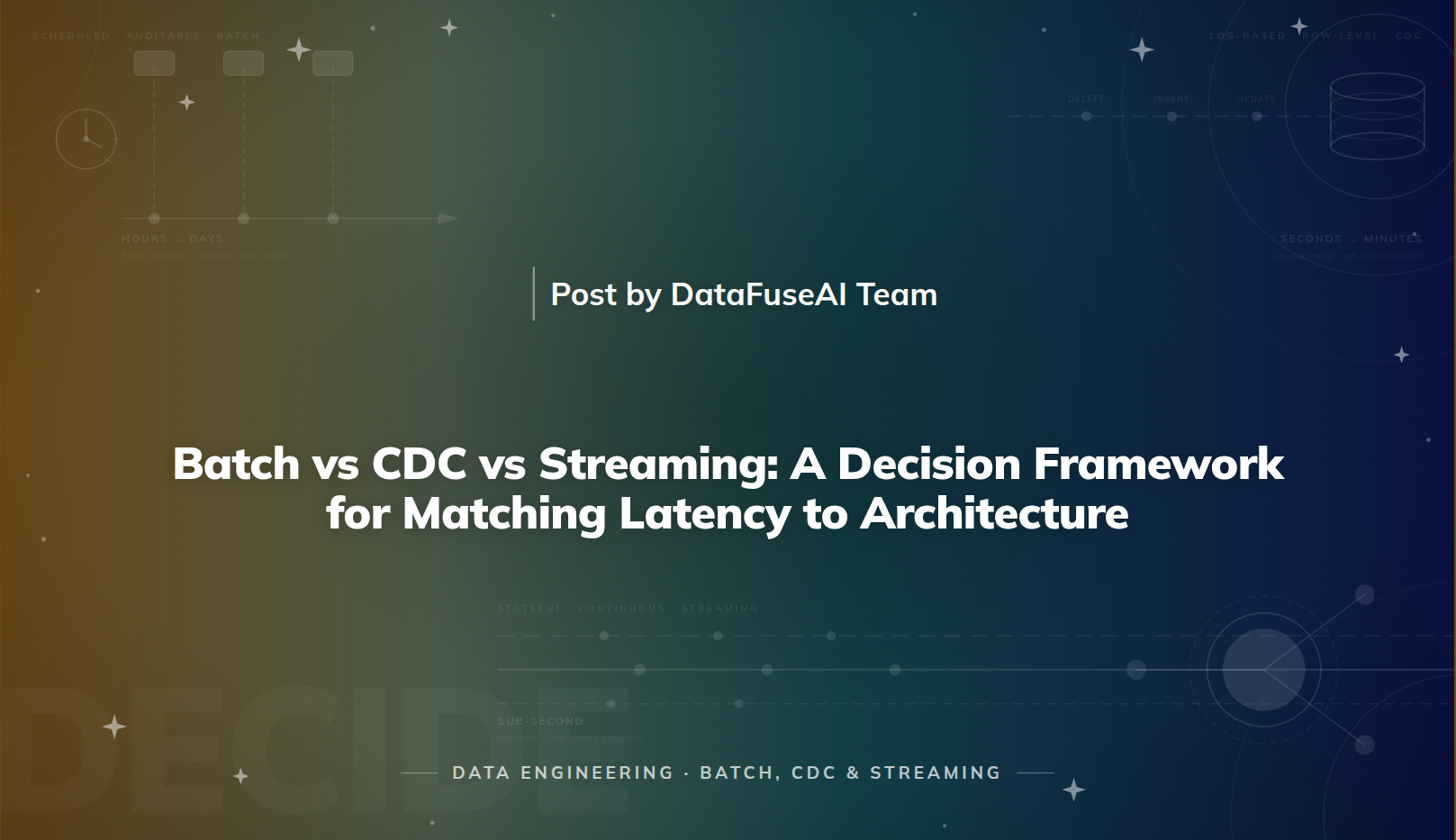
Every architecture review eventually hits the same question: should this pipeline run on a schedule, react to changes as they happen, or process a continuous event stream? The answer isn't which technology is newest. It's what the business SLA actually requires. Batch moves data on a fixed clock. Change data capture (CDC) replicates row-level changes as they commit. Streaming processes continuous events with stateful logic — windows, joins, aggregations — in real time. Pick based on the latency your decision actually needs, not the architecture getting the most attention this year.
- Batch, CDC, and streaming answer three different latency questions — they are not tiers of the same technology.
- Reconciliation, scheduled reporting, and regulated financial close still belong on batch, not because it's outdated but because it's auditable and predictable.
- CDC closes the gap between "what changed" and "when you know about it" without the operational weight of a full streaming stack.
- Streaming infrastructure carries real, recurring engineering cost — justify it against a decision that changes, not just a dashboard that refreshes faster.
- Most mature data platforms run a hybrid: CDC or streaming for the parts that need freshness, batch for the parts that need to be provably correct.
Use batch when correctness and auditability matter more than freshness — reconciliation, regulated reporting, large periodic transforms. Use CDC when downstream systems need to reflect source changes within seconds to minutes without the overhead of a full streaming stack. Use streaming when the pipeline itself has to make a decision — fraud scoring, alerting, live personalization — not just deliver data. The three aren't ranked by sophistication. A fraud-detection pipeline running on streaming and a monthly close running on batch can both be the correct architecture in the same company, sometimes touching the same source tables.
That framing matters because most comparisons treat this as an upgrade path — batch is legacy, CDC is the bridge, streaming is the destination. In practice, log-based CDC tools can deliver database changes with millisecond-range capture delay at the source, but that's a different claim than saying the business needs millisecond decisions.[3] The gap between "the data arrived fast" and "the business needed it fast" is where most streaming projects overspend.
Start With the Business Latency Requirement
Before naming a technology, name the SLA. Ask what happens if the data is one hour late, and what happens if it's one day late. If nothing downstream changes — no alert fires differently, no decision reverses — the latency requirement is looser than the architecture conversation assumes.
| Business need | Typical tolerance | Likely architecture |
|---|---|---|
| Fraud/risk scoring | Sub-second | Streaming |
| Live inventory or pricing | Seconds | Streaming or CDC + stream processing |
| Operational data sync | Seconds to minutes | CDC |
| Ops dashboards | Minutes to hourly | CDC or micro-batch |
| Standard BI reporting | Hourly to daily | Batch |
| Month-end financial close | Scheduled, auditable window | Batch |
| Regulatory/compliance extracts | Fixed reporting period | Batch |
| Data warehouse historical loads | Nightly or weekly | Batch |
Tolerance bands are directional. Confirm against the actual downstream decision, not the source system's technical capability.
What Batch Does Particularly Well
Month-end close is the clearest case. SOX Section 404 requires documented internal controls over financial reporting, and reconciliation is typically one of the first controls an auditor reviews.[1] That documentation requirement rewards a process that runs on a fixed schedule, produces a repeatable output, and leaves an audit trail — which is exactly what a batch job does and what a continuously mutating stream does not.
Example: A finance team closing the books pulls the general ledger, bank statements, and sub-ledger balances as of a defined cutoff, runs matching rules, and produces a reconciled trial balance. If that extraction happened continuously instead of at a defined point in time, the "as of" boundary that auditors rely on disappears. The batch job isn't a limitation here — the fixed snapshot is the control.
Batch also wins on large periodic transforms: warehouse preparation, big joins across historical tables, and reprocessing runs where correctness across the full dataset matters more than any single record's freshness. These jobs are simple to schedule, cheap to retry end-to-end, and don't require the operational discipline of a system that's never allowed to fall behind.
Where CDC Is the Better Choice
CDC earns its place when the requirement is specifically "keep this downstream copy of the data current," not "process events as they happen." Log-based CDC reads a database's transaction log directly rather than repeatedly querying tables, which means it captures inserts, updates, and deletes with far less load on the source system than a scheduled batch extract.[2] That makes it well suited to operational data sync, incremental replication into a warehouse, and cache invalidation — cases where the goal is parity between source and destination, not stateful processing on top of the change feed.
It's also the more honest choice than jumping straight to streaming for teams that don't yet have an event-driven use case. CDC gives you freshness without requiring you to build stream processing logic, manage windowing, or run a message broker cluster. If the actual requirement turns out to need real-time computation later, a CDC feed is a natural upstream source for a streaming layer — it doesn't have to be replaced.
Where Streaming Is Justified
Streaming is the right call when the pipeline has to compute something continuously, not just deliver a record fast. Fraud detection, real-time bidding, telemetry-driven alerting, and live operational decisioning all depend on stateful logic running against a moving window of events — joining a transaction against recent history, aggregating counts over a rolling interval, or triggering an action the instant a threshold is crossed.
Example: A payments platform scoring transactions for fraud needs to compare each new transaction against a rolling window of the account's recent activity before approving it. That comparison has to happen inline, in the path of the transaction, which is a fundamentally different problem than replicating a changed row to a warehouse. This is the workload event-native infrastructure like Kafka was built for, and it's also the workload that justifies the operational investment that infrastructure requires.
The Decision Matrix
Weigh these dimensions together rather than picking on latency alone. A workload can need low latency and still be a poor fit for streaming if correctness and replay matter more than speed.
| Dimension | Batch | CDC | Streaming |
|---|---|---|---|
| Latency | Hours to days | Seconds to minutes | Sub-second to seconds |
| Correctness model | Full recompute, easy to audit | Incremental, order-sensitive | Incremental, requires explicit state management |
| Source system impact | Higher during extraction window | Low, reads transaction log | Low per-event, high if stream volume spikes |
| Failure recovery | Rerun the job | Resume from log position | Requires replay, checkpointing, exactly-once handling |
| Operational ownership | Scheduler and job monitoring | CDC connector health, schema drift | Cluster, broker, and stream-processing lifecycle |
| Best fit | Reconciliation, reporting, large transforms | Operational sync, incremental replication | Fraud/alerts, telemetry, live decisions |
Hybrid Patterns Are Normal
Treating this as a single choice for the whole company is the actual mistake, more than picking the wrong technology. Most production data platforms run more than one of these patterns against the same source systems, split by what each downstream consumer actually needs.
Example: A retailer runs CDC to keep its operational order database synced into a reporting warehouse throughout the day, giving ops teams near-current visibility into order status. Overnight, a separate batch job reprocesses the full day's transactions against the general ledger to produce the reconciled figures finance uses for reporting. The CDC feed and the batch job read from related tables but serve different consumers with different tolerance for a wrong number. Neither replaces the other.
Another common pattern pairs streaming for the narrow slice that needs it — say, real-time fraud alerts — with a nightly batch job that recomputes the "truth" dataset used for downstream analytics and model retraining. The streaming path optimizes for speed on a small, well-defined decision. The batch path optimizes for completeness and auditability on everything else.
Where DataFuseAI Fits
DataFuseAI is built for the scheduled, batch, and hybrid side of this framework: pipeline orchestration and automation across fragmented source systems, with a drag-and-drop pipeline builder that mirrors the underlying execution architecture rather than hiding it. It runs on Databricks, Apache Livy, or its own native engine depending on workload, and supports deployment as managed cloud SaaS, private-hosted, or fully offline on-premise — the last of which matters directly for the regulated, auditable batch scenarios described above, since it runs entirely inside the customer's private network with no external internet dependency.
For teams standardizing reconciliation, scheduled reporting, or large periodic transforms across 50-plus source connectors, that's the workload DataFuseAI is built to run reliably, with action-level RBAC and full execution audit logging supporting the same documentation requirements SOX-style controls demand.
Map Your Own Pipeline Against This Framework
Take one existing workflow and check whether its actual SLA calls for batch, CDC, streaming, or a hybrid of the two — before the next architecture review makes the call for you.
When DataFuseAI Is Not the Answer
If the workload is sub-second and event-native — fraud scoring, live bidding, telemetry-driven alerting — that belongs on dedicated streaming infrastructure, not a batch or hybrid orchestration platform. DataFuseAI does not support streaming sources such as Kafka, Kinesis, or Pub/Sub, and its ELT capability is currently in beta rather than generally available. Teams whose primary requirement is continuous stateful processing should evaluate an event-streaming platform first and treat batch orchestration as the layer that handles everything else, not the other way around.
A note on scope: This is a deliberate boundary, not a gap to be closed later. A platform optimized for scheduled and hybrid pipeline reliability makes different architectural trade-offs than one optimized for continuous stream processing. Trying to be both usually means being adequate at neither.
Frequently Asked Questions
No. CDC replaces batch specifically for workloads that need low-latency replication of changing records, such as operational sync or near-real-time analytics. Scheduled reporting, month-end reconciliation, and large periodic transforms still run more predictably and cheaply as batch jobs. Most mature data platforms run both, not one instead of the other.
Yes, and it's the most common pattern in production. A typical design uses CDC to keep an operational data store in sync in near real time, then runs a nightly or hourly batch job against that same store to produce the audited, reconciled dataset used for financial or compliance reporting.
CDC and streaming overlap more than most comparisons admit. Log-based CDC tools can deliver changes with millisecond-range capture delay, but end-to-end latency depends on the downstream pipeline. True streaming architectures add continuous stateful processing — windowing, joins, aggregation — on top of that change feed, which is the part that actually requires event-native infrastructure like Kafka.
When no downstream decision actually depends on sub-minute data. If the output feeds a daily dashboard, a monthly report, or a scheduled reconciliation, real-time infrastructure adds operational cost and failure surface without changing any outcome. The test is whether a human or system acts differently because the data arrived in seconds instead of hours.
It narrows them. Regulated environments often require documented, auditable, repeatable processing windows, which batch and scheduled CDC handle naturally. Fully offline or air-gapped environments can rule out managed streaming services entirely, since those typically depend on external cloud infrastructure.
 Request a Demo