

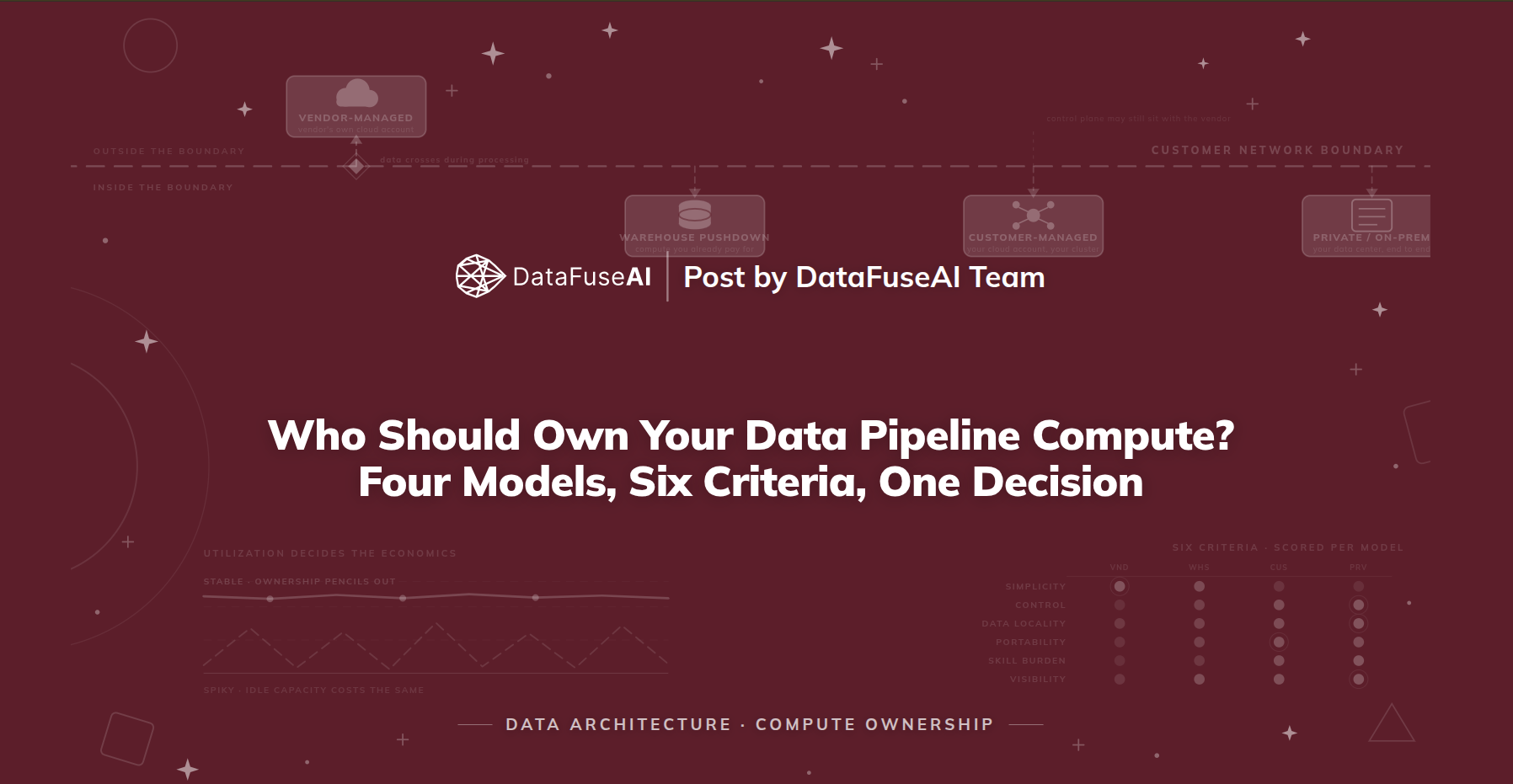
Ask five data leaders who should run pipeline compute and you'll get five confident, contradictory answers. One swears by warehouse pushdown. Another spent two years and a mid-six-figure budget standing up a self-managed Spark cluster and won't go back to renting one. A third inherited a Databricks contract nobody wants to unwind before the term ends. Most comparisons collapse this into a single axis — usually cost — and call it settled.
That framing skips the variables that actually decide it: security posture, data locality obligations, cost governance maturity, existing platform investment, and how much operational depth the team can realistically sustain. Get the mix wrong and the result is either a compliance gap or an infrastructure bill nobody can explain by March. What follows is a framework for scoring the decision against your own constraints — not a verdict that one model wins.
Four Common Ownership Models
Compute ownership breaks into four recurring patterns, and most mid-market and enterprise data organizations run more than one at once — whether they planned to or not. Each one answers a different question: who provisions the machines, where the bytes actually get processed, and who's on call when a job fails at 3 a.m.
| Model | Where Compute Runs | Who Operates It | Primary Cost Driver |
|---|---|---|---|
| Vendor-managed SaaS compute | Inside the platform vendor's own cloud account | The vendor — provisioning, patching, scaling, failover | Consumption-based platform fee |
| Warehouse pushdown | Inside the customer's existing warehouse (Snowflake, BigQuery, Redshift, etc.) | Shared — warehouse vendor runs the engine, customer governs the workload and spend | Warehouse compute credits already being paid for |
| Customer-managed Spark / Databricks | Inside the customer's own cloud account, on infrastructure the customer configures | The customer's platform or data engineering team | Cluster compute-hours plus engineering headcount |
| Private / on-premise compute | Inside the customer's own data center or private network | The customer's infrastructure team, end to end | Hardware capex, power, facilities, and staffing |
None of the four is a default, and none is disqualified by definition. Each trades operational control for a different kind of leverage — speed, spend, or oversight — and which trade makes sense depends on what the pipeline actually does, not on which model shows up first in a vendor's pitch deck.
What Changes When the Vendor Owns Compute
Vendor-managed compute removes a job, not a decision. Nobody on the data team tunes cluster sizes, patches a runtime, or plans capacity ahead of a seasonal spike — the platform absorbs all of it. For teams without dedicated platform engineers, that's often the entire case, and it's a legitimate one.
What it also does is move three things outside the customer's direct control. First, data has to leave the customer's network boundary to reach the vendor's compute, even when both parties sit in the same cloud region. Second, pricing becomes largely opaque — consumption-based billing is easy to start and hard to forecast once workloads scale unevenly. Third, portability narrows: workloads built against a vendor's proprietary execution engine or scheduling model don't lift out cleanly if the contract ends or the pricing stops working.
Shared responsibility, not transferred responsibility. NIST's cloud computing guidance formalizes what this actually means in practice: the provider secures the infrastructure it operates, but the customer remains accountable for data classification, access configuration, and workload-level controls no matter who runs the compute underneath.[1] A vendor-managed model changes who patches the server. It does not change who answers for a misconfigured permission.
When Warehouse Pushdown Makes Sense
Pushdown means executing transformation logic — joins, aggregations, window functions — inside the compute a customer already pays for in Snowflake, BigQuery, Redshift, or an equivalent warehouse, instead of standing up a second engine to do the same work outside it. It's the quietest of the four models because it doesn't introduce anything new; it just uses what's already governed and already paid for.
It earns that trust under specific conditions: access controls, lineage, and audit logging already live in the warehouse, most transformations are SQL-shaped, and the warehouse's elastic compute already absorbs volume spikes without a separate capacity plan. Consider a mid-market retailer already running its BI stack on a cloud warehouse — pushing transformation logic into that same warehouse means one system to secure, one bill to govern, and no second compute layer to patch. That's a representative, not a documented, scenario, but the mechanics generalize well.
It breaks down just as predictably. Machine learning feature engineering, unstructured data processing, and custom procedural logic routinely exceed what a SQL engine handles cleanly, and heavy transform workloads can inflate warehouse compute spend faster than a dedicated engine would have cost. Pushdown is a strong default for the SQL-shaped half of most pipelines — not a substitute for a compute layer built to do the other half.
When Customer-Owned Compute Is Valuable
Customer-owned compute — a self-managed Spark cluster or a Databricks deployment configured and run by the customer's own team — earns its complexity under a narrower set of conditions than vendor pitches usually admit. Four show up repeatedly in practice.
Existing platform investment is the most common. A team that already has Databricks or Spark fluency, existing job definitions, and tuned cluster configurations pays a real cost to abandon that and re-platform onto something new — and often doesn't need to. Network restrictions are the second: environments that prohibit outbound calls to third-party SaaS platforms by policy simply can't route pipeline compute through a vendor's cloud account, full stop. Cost control at genuine scale is the third, but only when utilization is high and stable enough to make ownership pencil out. The fourth is data residency — some workloads legally cannot leave a defined jurisdiction during processing, which forces physical control over where compute runs, independent of what it costs.
What "customer-managed" doesn't always mean. Ownership isn't always as clean as it sounds. Platforms like Databricks split a control plane — vendor-hosted, handling orchestration and the UI — from a data plane that runs inside the customer's own cloud account, where data is actually processed. The operational boundary and the data boundary aren't identical, and that distinction matters more than the marketing term "customer-managed" suggests when a security review asks exactly where data goes.
The Security and Networking Dimension
Four things change across the four models, and all of them show up on a security review before they show up on an invoice: where data physically moves, who holds the credentials that reach it, whether traffic can stay on private networking or has to cross a public endpoint, and how completely the resulting audit trail can be reconstructed after the fact.
Data residency adds a wrinkle most cost-first comparisons skip entirely: regulators generally don't limit their definition of a "transfer" to where data is stored at rest. The EDPB's guidance on international transfers treats data made available to infrastructure outside an approved jurisdiction as a transfer regardless of whether that access is temporary, ancillary, or purely for processing.[2] A vendor's compute layer sitting in the wrong region for even the duration of a job can trigger the same obligations as long-term storage there — which is a networking and jurisdiction question first, and a pricing question a distant second.
The Economics Dimension
License or compute-hour cost is one line on a much longer bill. The full economics of compute ownership include data movement charges, how efficiently the capacity actually gets used, and the operational labor required to keep it running — three variables a per-unit price comparison leaves out entirely.
Data movement is the clearest example. Every major cloud provider prices outbound data transfer well above what it charges to store the same data, and that asymmetry has functioned as a quiet tax on switching compute providers for years. Regulation is starting to catch up: under Article 29 of the EU Data Act, cost-based switching charges — including the egress fees incurred while leaving a provider — remain permitted only through January 12, 2027, after which providers serving EU customers can no longer charge them at all.[3] That's a structural argument for factoring exit cost into a compute ownership decision now, not after a contract renewal forces the question.
Utilization is the harder variable, and it's where ownership economics most often fail in practice. 37signals, the company behind Basecamp and HEY, publicly documented moving seven applications off AWS onto owned hardware, citing stable, predictable workloads as the precondition for the move — its reported cloud spend fell from roughly $3.2 million a year to about $1.3 million within two years of starting the migration.[4] That's general infrastructure economics, not a pipeline-specific benchmark, and it doesn't generalize to every workload. The mechanism does transfer directly, though: fixed, predictable utilization favors ownership. Bursty, unpredictable utilization favors rental, because idle owned capacity costs the same as busy owned capacity.
- Workload volume is stable and forecastable month over month
- A platform engineering function already exists to operate the infrastructure
- Utilization consistently runs high enough to avoid paying for idle capacity
- Workload volume is spiky, seasonal, or still finding its shape
- No one is dedicated to patching, sizing, and monitoring the cluster
- Compute would sit idle most of the time between processing windows
Neither column is a verdict on its own. A workload can score well on utilization and still fail on skill burden, and that combination is common enough that it belongs in the scorecard below rather than getting resolved by cost alone.
Decision Matrix
Score each candidate model against the same six criteria before committing to one. None of these is binary — the point is relative comparison across the row, not a pass/fail gate on any single column.
| Criterion | Vendor-Managed | Warehouse Pushdown | Customer-Managed | On-Premise / Private |
|---|---|---|---|---|
| Simplicity | Highest — no infrastructure to run | High — reuses existing warehouse ops | Low — full platform engineering required | Lowest — full stack, including hardware |
| Control | Lowest — vendor sets runtime and roadmap | Medium — bounded by warehouse capabilities | High — customer configures the runtime | Highest — complete infrastructure control |
| Data locality | Depends on vendor's region options | Matches wherever the warehouse already sits | Customer chooses the region directly | Fully customer-determined, including offline |
| Portability | Low — often tied to a proprietary engine | Medium — SQL is broadly portable, warehouse isn't | High — open frameworks, standard formats | High, constrained by hardware lifecycle |
| Skill burden | Lowest on the data team | Low — extends existing warehouse skills | High — dedicated platform engineering needed | Highest — infrastructure and platform teams |
| Visibility / auditability | Limited to what the vendor exposes | Strong, inherited from warehouse governance | Full, if the team builds it | Full, entirely in-house |
Scores are directional and relative, not absolute — a vendor with strong regional controls can outscore this baseline on locality, and a poorly staffed self-managed cluster can underscore it on skill burden.
As a starting point rather than a prescription: a seed-to-Series-B startup with no dedicated platform team usually starts with vendor-managed or pushdown and revisits later. A scaling SaaS company with predictable volume and an existing data platform team is the profile where customer-managed compute most often pencils out. A regulated enterprise or public-sector team with hard data-locality mandates typically ends up evaluating private or on-premise compute regardless of what it costs relative to the alternatives. For a deeper walkthrough of the deployment-location decision this pairs with, see the framework for choosing between managed cloud, private-hosted, and on-premise ETL.
The DataFuseAI Approach
DataFuseAI doesn't force a single ownership model onto every customer, because the framework above makes clear that no single model fits every workload. The platform supports three GA deployment models — managed cloud SaaS, private-hosted, and on-premise offline — and lets pipelines run on Databricks, Apache Livy, or DataFuseAI's own native engine, without locking a team into one compute layer to get started.
That matters most for the residency and control-plane concerns raised earlier in this piece. The on-premise offline deployment model runs entirely within a customer's own private network, with no external internet dependency at all — which resolves the data-locality question directly, rather than asking a team to architect around a vendor's control plane sitting somewhere else. Teams with an existing Databricks or Spark investment keep it; teams without one aren't required to build one just to get pipelines running.
That flexibility has a boundary worth stating plainly: DataFuseAI's native engine is built to make ownership a deployment setting, not to out-perform a purpose-built Spark cluster on exotic, custom machine learning feature pipelines. Teams running that kind of workload at real scale should expect to route it through Databricks or a similarly specialized engine — DataFuseAI's job there is orchestration and governance around that compute, not replacing it. Full platform, deployment, and governance and compliance details are available for teams evaluating a specific workload against the criteria above.
Frequently Asked Questions
No. Ownership pays off only under specific conditions: stable, predictable utilization, existing platform expertise on staff, and workload volume high enough to offset engineering time and hardware or reserved-capacity spend. On spiky or low-utilization workloads, idle capacity and operational labor routinely erase any per-unit compute savings. Treat cost as one input to the decision, not the deciding one.
For SQL-shaped transformations — joins, aggregations, window functions — pushdown into an existing warehouse often removes the need for a dedicated engine entirely. For machine learning feature engineering, unstructured data processing, or custom procedural code, most warehouses still hit a ceiling, and a separate compute layer becomes necessary again.
Yes. Regulatory frameworks generally treat data made available to infrastructure outside an approved jurisdiction as a transfer, whether that data is at rest or only being processed. If a compute layer sits outside a permitted region — even briefly, during a single job — that can trigger the same obligations as long-term storage there, which rules out vendor-managed or multi-region compute for some workloads regardless of cost.
It changes one input. From January 12, 2027, providers serving EU customers can no longer charge switching charges, including data egress fees, under Article 29 of the Data Act. That removes a real exit cost that has historically locked organizations into vendor-managed compute longer than the underlying economics justified. It does not change the operational or security variables that also drive the decision.
It requires dedicated platform engineering capacity, not just a data engineer who can write Spark jobs. Someone needs to own cluster sizing, patching, cost monitoring, failure recovery, and access control on an ongoing basis. Teams that underestimate this typically end up with an unmonitored cluster running at a fraction of its intended utilization — which is exactly where customer-owned compute economics fail.
The compute ownership question doesn't get settled once. It resurfaces every time a contract renews, a regulator issues new guidance, or a pipeline's growth curve bends in a direction nobody modeled. Treat it as a standing architecture decision that gets re-scored, not a platform choice made once at launch and left alone — because the variables that decide it, regulation, utilization, and team depth, rarely stay fixed for long. Score your next production pipeline against the six criteria above before the next renewal forces the question for you.
 Request a Demo