

Every build vs buy calculator for data pipeline infrastructure starts in the wrong place. It compares initial development cost to annual license cost — and stops there. The comparison is technically accurate and practically useless, because the number that drives the actual outcome isn't on the screen. It appears 18 months later, in a quarterly headcount review, when someone asks why three senior engineers are spending most of their time on pipeline maintenance instead of the work they were hired to do.
Vendors have an obvious interest in making their ROI calculators favor a buy conclusion, which creates a reasonable instinct to be skeptical of them. Teams that run the calculation themselves often arrive at the same answer — but for the wrong reasons, comparing costs that don't reflect what the decision actually commits them to. The calculation no one runs is the one that accounts for what building means operationally, not just technically: who maintains this, for how long, under what compliance requirements, when those engineers are worth $130,160 in median annual salary[1] before you account for benefits, overhead, and the work they don't get to do while maintaining custom pipeline code.
This piece makes a specific argument: the build vs buy decision for data pipeline infrastructure is primarily a staffing decision, not a software decision. Once you understand it that way, the cost structure of the choice changes entirely.
The Build Decision Is a Staffing Decision
Software costs follow a predictable model. Licenses scale with usage, users, or data volume, and the pricing is set at contract time. You know what you're committing to. Staffing obligations don't work that way. They compound.
When a team decides to build its own data pipeline infrastructure, it's not making a software decision. It's making a commitment to own a software product indefinitely. That product will require engineers to build it, engineers to maintain it, engineers to extend it as requirements change, and engineers to respond when it fails — at 2am, on a Friday, during the month-end financial close, or when the source system your pipeline depends on changes its API without warning.
The word "indefinitely" is doing significant work in that sentence.
Most build estimates are scoped to the initial construction phase: sprint estimates, architecture diagrams, a go-live date. The construction phase is the part that feels bounded and manageable. What's not in the estimate is the operational phase — which begins at go-live and continues until someone makes an active decision to decommission the system. For data infrastructure, that decision rarely arrives. Pipelines accumulate. Each new business requirement adds connectors. Each new compliance obligation adds transformation steps and audit logging. Each source system upgrade requires pipeline changes on your side, on your schedule, absorbed by your team.
There's a version of this story where the engineering team stays small, the pipeline requirements stay stable, and the system runs cleanly for years. Teams try it. It works until the third source system changes its authentication model in the same quarter that a new GDPR data processing agreement restricts what can move to which destination.
Building data pipeline infrastructure doesn't save a software budget. It converts that budget into an engineering headcount obligation — one whose cost curve is steeper and less predictable than any license fee.
The U.S. Bureau of Labor Statistics reports a median annual wage of $130,160 for software developers as of May 2024,[1] and senior data engineers command wages above that median. Fully loaded costs — including employer-side payroll taxes, benefits, equity, and overhead — materially exceed the base salary figure. That's the cost of one engineer. Most non-trivial custom pipeline systems require more than one to build, and at least one to maintain continuously in production.
The question isn't whether that investment is worth making. Sometimes it genuinely is. The question is whether it's being made with an accurate view of what it commits the organization to — not for the next sprint, but for the next three to five years.
Four Cost Categories That Don't Appear in the First Estimate
Build estimates have a consistent blind spot. They account for the time to write the code. They don't account for the conditions under which that code must operate over its lifetime. Four specific cost categories appear in almost every post-mortem of a custom pipeline build that went over budget — and in almost no build estimate that preceded it.
1. Schema drift and connector maintenance
Every source system your pipeline connects to will change over time. Database schemas get new columns, renamed fields, changed data types. APIs introduce versioned endpoints and deprecate old ones. File formats shift. Authentication mechanisms update. For each connection, your pipeline either handles the change gracefully or it fails. Graceful handling requires someone to anticipate, detect, and implement the change — on a timeline driven by the source team, not yours.
The connector count compounds this. A pipeline connecting five sources isn't five times the maintenance burden of a pipeline connecting one source — it's five separate dependencies, each on its own change schedule, each capable of producing a pipeline failure independently. At ten, fifteen, twenty sources — which is not unusual for a mid-market analytics environment — the connector maintenance obligation becomes a standing queue of work that never empties.
Commercial platforms absorb this cost. Their engineering teams maintain the connectors, handle API versioning, update authentication integrations. When a connector breaks, the platform fixes it. When you build your own, you fix it — or the pipeline sits broken until you do.
2. Security and compliance infrastructure
Custom pipeline infrastructure requires you to own the security posture for everything that code touches: encryption in transit and at rest, access control over who can trigger runs and read outputs, audit logging that captures user, action, and configuration state, and the documentation trail that demonstrates to an auditor that your controls are operational and have been continuously for the review period.
NIST SP 800-53 Rev. 5[2] defines the control families that govern these requirements for information systems — access control (AC), audit and accountability (AU), configuration management (CM), and identification and authentication (IA). For organizations subject to SOX, HIPAA, or GDPR, these aren't optional considerations. They're auditable obligations that must be demonstrated, not just implemented. Implementing them in a custom system is a one-time project. Demonstrating them continuously to an auditor — maintaining logs, preserving evidence of control operation, updating documentation when configurations change — is an ongoing operational responsibility.
Commercial platforms with action-level RBAC, full execution audit logging capturing user, action, and configuration state, and configurable deployment models that allow processing to stay within a private network shift that compliance infrastructure responsibility to the vendor. The internal obligation moves from "build and maintain the control" to "verify the vendor maintains the control and document your verification." That's a materially smaller operational burden.
On compliance posture as a cost dimension: Teams frequently treat security and compliance infrastructure as a one-time implementation cost rather than an ongoing operational obligation. The implementation cost is real. The maintenance cost is larger. Each time an access policy needs updating, a new data processing agreement changes what audit logs must capture, or a regulation requires re-evaluation of your encryption standards, the compliance infrastructure requires change — and that change must be tested, documented, and validated before the next audit cycle.
3. Engineer opportunity cost
Every hour a data engineer spends maintaining pipeline code is an hour not spent on the work that differentiates your analytical capabilities or your product. This isn't a philosophical point about focus. It's a direct financial tradeoff with a quantifiable cost: the hourly rate of a senior data engineer applied to maintenance work that produces no new capability, at the frequency that maintenance is required.
For custom pipelines operating across a dozen source systems, maintenance work is continuous rather than episodic. Source changes, debugging silent failures, updating transformation logic as business definitions evolve, handling edge cases that the original design didn't anticipate — each is legitimate engineering work, and each diverts the same engineering capacity from building new capabilities. Teams operating this way are paying senior engineering rates for maintenance work while simultaneously experiencing slower progress on analytical product development. Both costs are real. Only the maintenance cost appears in the annual infrastructure budget; the opportunity cost is invisible until the roadmap review shows that the planned analytics features are six months behind schedule.
4. Knowledge concentration risk
Custom pipeline systems accumulate institutional knowledge in the engineers who built them. The codebase reflects the decisions those engineers made, the edge cases they encountered, the workarounds they implemented for sources that behaved unexpectedly. That knowledge lives in their heads as much as it lives in documentation — and documentation, for custom internal infrastructure, is rarely comprehensive.
When those engineers leave — and engineering turnover rates make this a planning assumption rather than a contingency — the knowledge leaves with them. What remains is a running system whose failure modes aren't fully understood by the team currently responsible for it. The first incident after a key engineer's departure is the moment the knowledge gap becomes a business-impacting event. The cost of that incident isn't just the recovery time; it's the investigation time, the risk of incorrect fixes, and the potential for downstream data quality issues that propagate into reporting before anyone identifies the root cause.
This risk is concentrated in exact proportion to how custom and how undocumented the system is. Commercial platforms externalize this knowledge by design: the behavior is documented, the support is available, and the system operates the same way regardless of which engineer is on call.
Why Maintenance Costs More Than the Build Over Time
Software maintenance is not a minor line item relative to initial development cost. It is, over any multi-year horizon, the larger category — a well-documented principle in software engineering literature going back to foundational studies on the software development lifecycle.[3] Development produces the system. Maintenance pays for it to exist.
Data pipeline infrastructure accelerates this pattern for a specific structural reason: the inputs to the pipeline are owned by external teams whose change schedules are independent of yours. Application developers change schemas when product features require it, not when the pipeline team has bandwidth. Source system vendors release API versions on their roadmap, not yours. Compliance requirements expand when regulators update guidance, not when your sprint is clear.
Each of these changes generates maintenance work on your side that can't be batched, prioritized away, or deferred indefinitely without accepting pipeline failures. The maintenance is demand-driven rather than schedule-driven, which makes it resistant to the kinds of capacity management that work for greenfield development. You can't tell a source system's engineering team to hold their schema migration until your Q3 roadmap has room for it.
Commercial pipeline platforms face this same problem — their connector teams handle the same schema drift and API changes. The difference is that their maintenance cost is distributed across all customers who depend on that connector, absorbed by a dedicated team whose full-time responsibility is keeping the integration current. Your cost is absorbed by the same engineers who are also responsible for building new capabilities, supporting business users, and responding to data quality incidents.
The maintenance multiplier compounds further when compliance requirements evolve. A pipeline built to GDPR requirements in 2020 may require architecture changes as EDPB interpretive guidelines clarify what "appropriate technical measures" under Article 32 require for specific processing categories.[4] A pipeline built to SOX IT control requirements may require documentation updates when audit firm interpretations shift. None of this work was in the original build estimate because the regulatory guidance didn't exist yet. All of it is the inevitable consequence of operating in a regulated environment over a multi-year horizon.
When Building Is Actually the Right Decision
This argument would be dishonest without a genuine counterargument. There are conditions where building is the right decision — not as a cost-saving measure, but because the alternative is genuinely unavailable or inadequate. Three of them are real.
Your requirements cannot be met by any available commercial product — and you can name them specifically. Not "we have unique needs" as a general statement, but a specific technical or functional requirement that you've verified cannot be addressed by the configuration options, custom transformation logic, or connector extensibility of any platform you've evaluated. This condition is rarer than teams believe when they start the evaluation. Requirements that appear unique on first examination frequently resolve into configuration decisions once a technical evaluation is underway. Requirements that persist as genuinely unaddressable after rigorous evaluation justify building.
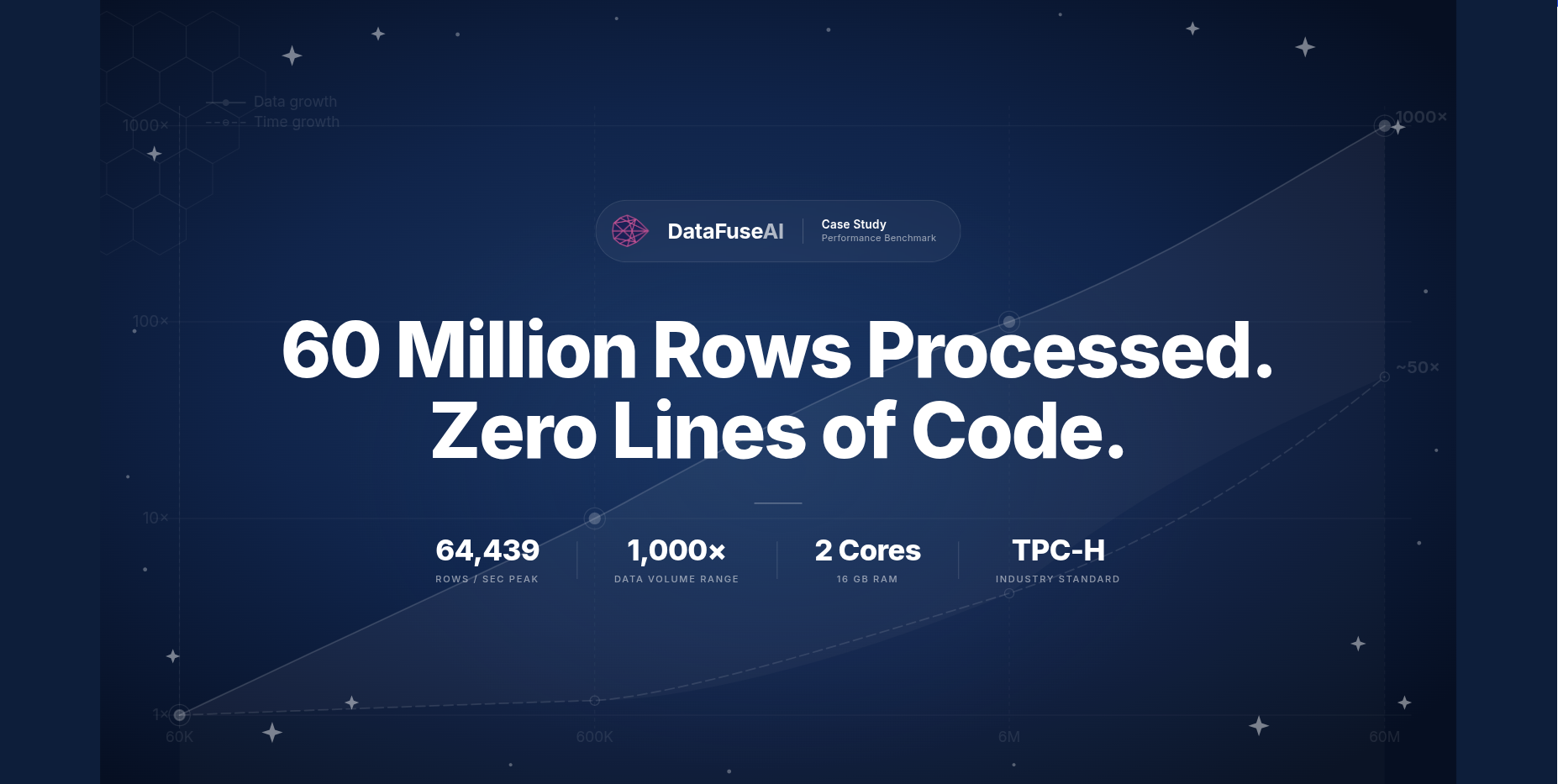
Your data volumes or compute requirements exceed what any vendor supports. Some organizations operate at scales where commercial platforms either can't handle the throughput or price it at a level that makes the economics unfavorable even after accounting for the full maintenance cost of building. This is less common than it sounds — commercial platforms have extended their scale ceilings significantly — but it's a genuine condition. The relevant data point here is what the platform has actually demonstrated: DataFuseAI processed 60 million rows per pipeline run on a 2-core 16 GB Databricks cluster, reaching 64,439 rows per second at peak throughput.† For organizations whose requirements are in this range, the performance argument for building is weak. For organizations whose requirements are genuinely beyond what any platform can demonstrate, building may be necessary.
Your regulatory environment prohibits third-party data processors. Government contractors operating under classified data handling requirements, defense-adjacent organizations under zero-egress network policies, and some healthcare organizations under particularly restrictive data processing agreements genuinely cannot route data through vendor infrastructure. For these organizations, the build vs buy question is answered by compliance requirement before cost ever enters the calculation.
On "unique requirements" as a build justification: The most common reason teams choose to build — "our requirements are unique" — is also the most frequently incorrect. Before committing to a build, run a specific technical evaluation: document the exact requirement that commercial products can't meet, then test whether that's actually true. Requirements that survive rigorous evaluation justify building. Requirements that don't survive evaluation are expensive reasons to avoid a license negotiation.
Outside these three conditions, building is usually a choice made for other reasons: existing in-house capability that makes building feel tractable, organizational skepticism of vendor lock-in, a budget structure that makes capital expenses easier to approve than operating expenses. These are understandable organizational dynamics. They're not good reasons to take on the four cost categories described above, and teams that make the decision for these reasons typically encounter those costs anyway, 12 to 18 months after go-live.
The Question That Changes the Calculation
Most build vs buy analyses ask: "What does it cost to build this today?"
That's the wrong question. Construction cost is a one-time expenditure with a reasonably bounded estimate. The decision you're making is not about construction cost. It's about the fully loaded annual cost to maintain what you build — across the number of pipelines your organization will need, under the compliance posture your regulatory environment requires, for as long as the infrastructure is operational.
The right question is this: What is the total annual engineering cost — including salaries, benefits, overhead, and opportunity cost — to keep this system current, secure, compliant, and functioning, in year three, when we have fifteen source connections, two compliance frameworks, and two of the three engineers who built it have moved to other roles?
Teams that answer this question honestly before making the build decision arrive at clearer conclusions. Sometimes the answer supports building — when genuinely differentiating requirements exist, when scale demands it, when compliance requires it. More often, the answer surfaces the staffing obligation clearly enough that the license cost of a commercial platform looks different than it did when only construction cost was on the table.
Vendor ROI calculators don't walk you through this calculation because it complicates the sale. Internal build estimates don't walk you through it because the engineers doing the estimation are scoping the construction, not the operations. No one has a natural incentive to surface the full picture — which is exactly why most organizations discover it after the fact, in the quarterly headcount conversations where senior engineers are spending their time on maintenance work that doesn't make the roadmap move.
The piece of the calculation that matters is the one that never appears in the first estimate. Build the estimate that includes it, and the decision usually becomes clear on its own.
† DataFuseAI benchmark data from the published 60M Rows Case Study. Configuration: Databricks compute, 2 cores, 16 GB RAM. These are verified Layer 0 claims from DataFuseAI's published documentation.

 Request a Demo