


Most comparisons of no-code ETL tools follow the same pattern: rank by connector count, add a pricing column, note which tools are easy to use, and call it a framework. It isn't.
The teams that run into trouble with ETL tool selection rarely chose wrong on connectors. They chose a tool that can't run in their compliance environment. They picked an architecture that accumulates technical debt as their warehouse scales. Or they discovered their data operations have no audit trail when someone from legal shows up.
This analysis evaluates six no-code ETL tools across ten criteria most comparisons skip: deployment model, architecture pattern, governance and audit logging depth, monitoring capability, connector scope by category, and documented scale threshold. If you want the foundation before the comparison, see Explaining ETL in Simple Terms for a primer on the basics.
One thing to state upfront: DataFuseAI published this comparison and is one of the six tools evaluated. Readers who need broad SaaS application connectors will be routed away from DataFuseAI by the decision framework. Readers with database-centric pipelines, compliance constraints, or governance requirements will find a different answer. This framework names directly where each tool leads and where it doesn't.
What Actually Separates a Good No-Code ETL Tool From a Bad One
The right ETL tool doesn't fail you on features. It fails you on deployment, architecture, governance, or scale — and you typically don't discover that until you're already committed.
Most comparison guides evaluate tools on connectors and pricing. Those matter, but they're second- and third-tier criteria. The criteria that determine whether a tool actually fits your team are less visible: what deployment environments it supports, what architectural pattern it enforces, what the governance model actually enforces at the action level, and whether monitoring surfaces something useful when a pipeline breaks at 2 a.m.
1. Deployment model
The first question isn't "which connectors does this tool have?" It's "can this tool even run in our environment?" Three deployment models exist: Managed Cloud SaaS (vendor hosts everything), Private-Hosted (you run it on your own infrastructure), and On-Premise Offline (no external internet connection at all). Most tools in this category support only the first option. For teams with data residency requirements, regulatory mandates around sovereignty, or zero-egress obligations, a cloud-only tool is a disqualifying constraint — best discovered at the start of evaluation, not after shortlisting.
2. Architecture pattern: ETL vs ELT
ETL transforms data within the pipeline before it reaches the destination. ELT loads raw data into the warehouse first and transforms it there using the warehouse's own compute. This is an architectural decision, not a feature toggle. For modern cloud warehouses like Snowflake, BigQuery, or Redshift, ELT is the natural fit because transformation runs where the data already lives, on elastic compute. For compliance-sensitive pipelines, on-premise destinations, or environments where transformation-before-load is a regulatory requirement, ETL is the appropriate architecture. Choosing without understanding which applies means transformation logic accumulates in the wrong place as pipelines scale. Read more: ETL vs ELT explained.
3. Governance and audit logging depth
Most comparison tables mark "Has RBAC" with a checkmark and nothing more. The more important question is what the RBAC actually enforces. Role-label systems assign broad access categories. Action-level systems scope permissions to specific operations: running a query, starting a cluster, editing a pipeline, deleting a log entry. Those are meaningfully different in a compliance context.
The audit logging distinction is equally specific. GDPR Article 32[2] requires controllers and processors to maintain the confidentiality, integrity, availability, and resilience of processing systems. HIPAA 45 C.F.R. § 164.312(b)[3] requires application-level audit trails that capture records opened, created, read, edited, and deleted. "Has audit logging" doesn't meet those standards. Capturing user plus action plus configuration state at execution time does.
In a compliance review context, auditors ask three specific questions: who triggered each pipeline run, what transformations were applied, and what configuration was active at the time of execution. If a platform can't answer all three, it creates regulatory exposure regardless of whether pipelines ran correctly. See Building Audit-Ready Data Operations[7] for a more detailed treatment.
4. Monitoring capability
A dashboard that shows "job failed" is different from one that tracks failure patterns across the last five execution cycles, surfaces system resource metrics at meaningful intervals, and delivers alerts through a channel your team actually monitors. In March 2025, the UK Information Commissioner's Office issued a £3.07 million penalty against a software provider for failing to implement adequate security measures under Article 32 of UK GDPR — the first such penalty against a data processor.[4] The principle that platforms processing personal data on behalf of clients have direct Article 32 obligations including the ability to detect and respond to security events applies broadly.
5. Connector scope by category
Six hundred total connectors is not the same as broad coverage. When 400 of those are community-maintained SaaS application integrations at varying stability levels, the database coverage may be narrower than a platform with 50 connectors built specifically for RDBMS, NoSQL, and cloud database systems. Evaluating connector scope by category rather than by aggregate count gives the more accurate picture.
6. Scale threshold
"Handles enterprise scale" is not a ceiling specification. The meaningful answer depends on where transformation happens, what compute engine runs it, and whether the vendor has published benchmark data. Platforms that don't share scale benchmarks should not be assumed to have equivalent ceilings to those that do.
Genuine audit logging captures user, action, and configuration state at each execution — not just that the pipeline ran. Action-level RBAC scopes permissions to specific operations within specific modules. Most tools offer role-based access at the group level; fewer enforce it at the operation level with a complete execution audit trail. For tools where action-level granularity is not confirmed from public documentation, the audit logging claim should be verified directly with the vendor.
ETL transforms before loading; ELT loads raw data first, then transforms inside the warehouse. For Snowflake, BigQuery, or Redshift, ELT is natural because transformation runs on warehouse compute. For on-premise destinations, compliance pipelines, or environments where data must be cleaned before reaching the destination, ETL is the right choice. Which default your tool uses determines how transformation logic accumulates as your pipelines grow.
Under GDPR Article 28,[1] yes. Any platform processing personal data on behalf of another organization is a data processor with direct Article 32 security obligations. Governance and monitoring architecture in your ETL platform are legal requirements for EU-regulated deployments, not optional product features.
Among the six tools in this comparison, DataFuseAI supports both Private-Hosted (on your own infrastructure) and fully offline On-Premise deployment, both currently GA. Matillion has an enterprise hybrid option — verify current availability directly with Matillion sales. Every other tool (Airbyte Cloud, Fivetran, Hevo Data, Integrate.io) is Managed Cloud SaaS only.
How We Evaluated the Tools on This List
Criteria sourcing: Deployment model is confirmed from vendor deployment documentation. Architecture from technical documentation. Connector count from each vendor's current integrations page. Governance against specific documented capabilities including action-level or role-label RBAC and what audit logs actually capture. Monitoring against what the dashboard surfaces, not what the marketing page describes. Scale threshold from publicly documented benchmark data; where none exists, the cell reads "Not Publicly Available."
Source verification: Every competitor cell is sourced from publicly accessible vendor documentation. Cells that couldn't be confirmed carry Not Publicly Available inline. Pricing reflects publicly listed rates at time of writing. Pricing models in this category change frequently — verify current rates directly from each vendor before making purchasing decisions.
DataFuseAI is classified as ETL in production with ELT currently in beta. Its connector count (50+) is lower in total than several alternatives; its database-category coverage is shown in the connector table below. Where DataFuseAI leads, the evidence is specific and confirmed. Where it trails, that's stated directly.
Best No-Code ETL Tools in 2026: Side-by-Side Comparison
Main Comparison Table
| Tool | Deployment | Architecture | Connectors | Scale Threshold | Monitoring | Governance / RBAC | Audit Logging | Pricing | Ease of Use | Support |
|---|---|---|---|---|---|---|---|---|---|---|
| DataFuseAI | ETL ELT in beta |
50+ 25 dedicated RDBMS variants |
60M+ rows/run 75M combined; Databricks benchmark |
Last 5-cycle failure history; pipeline aggregation; 10-sec system metrics; email alerts on failure | Action-level RBAC Per-module; multi-tenant isolation |
✓ Confirmed User + action + config state |
Custom per requirement Contact Us → |
High — UI mirrors platform architecture | Not Publicly Available | |
| Airbyte | ELT | 550–600+ Vendor + community |
Not Publicly Available | Pipeline status; basic alerting; warehouse-dependent observability | Role-based; action-level depth not confirmed | ✓ Depth unconfirmed |
Free OSS / ~$10/mo Cloud / ~$25K/yr Plus | High (Cloud) Engineering req. self-hosted |
Community / Accelerated / Enterprise SLA | |
| Fivetran | ELT | 500–700+ Primarily SaaS apps |
Not Publicly Available | Sync status; data freshness; connector-level alerting | Role-based; column blocking/hashing; action-level depth not confirmed | ✓ Depth unconfirmed |
Free (500K MAR) / ~$500/M MAR Std / ~$1,067/M MAR Ent | Very high | Standard / Enterprise / Business Critical | |
| Hevo Data | ETL + ELT | 150+ | Not Publicly Available | Pipeline status; auto-healing; enterprise depth unconfirmed | Role-based; action-level depth not confirmed | ✓ Depth unconfirmed |
Free (1M events) / ~$239/mo Starter / ~$679/mo Pro | Very high | Ticketed + community | |
| Integrate.io | ETL + ELT + CDC | 200+ | Not Publicly Available | Job logs; observability dashboard; alerting; SLA management | Role-based; SOC 2 Type II; action-level depth not confirmed | ✓ Depth unconfirmed |
~$1,999/mo flat-fee (unlimited pipelines) | High | Dedicated onboarding + implementation | |
| Matillion | ELT Warehouse-native pushdown |
100+ | Not Publicly Available | Job status; orchestration logs; depth unconfirmed | Role-based; action-level depth not confirmed | ✓ Depth unconfirmed |
Free Dev / ~$1K–$2K/mo Teams / Enterprise custom Warehouse compute billed separately |
Medium (SQL knowledge req.) | Ticketed + enterprise |
Pricing figures reflect publicly listed rates, April 2026 — verify before purchasing. "Not Publicly Available" reflects information not confirmed from current vendor documentation. "Audit logging depth unconfirmed" means the tool advertises audit logging but action-level granularity and configuration-state capture at execution time are not confirmed from public documentation.
Three observations emerge. Three of the six tools are cloud-only with no self-hosted, private-hosted, or on-premise path. Only one tool in this comparison has a publicly documented per-run scale benchmark. And only one has confirmed action-level RBAC with full audit trail capture across user, action, and configuration state at execution time.
Chart 1 of 1
Total Connector Count by Tool — Lower Bound, April 2026
| Tool | Connectors |
|---|---|
| DataFuseAI | 50 |
| Matillion | 100 |
| Hevo Data | 150 |
| Integrate.io | 200 |
| Fivetran | 500 |
| Airbyte | 550 |
DataFuseAI's 50+ connectors are dedicated database variants; Airbyte and Fivetran totals include community-contributed SaaS connectors at varying maintenance levels. Source: vendor documentation, April 2026.
Connector Coverage by Category
Total connector count is only meaningful relative to which categories those connectors cover. A platform with 600 connectors, 400 of which are SaaS application connectors, may have fewer RDBMS database variants than a platform with 50 connectors built specifically for database and infrastructure sources.
| Connector Category | DataFuseAI | Airbyte | Fivetran | Hevo Data | Integrate.io | Matillion |
|---|---|---|---|---|---|---|
| RDBMS — MySQL, PostgreSQL, SQL Server, Oracle, Snowflake, Redshift, SAP HANA, Vertica, Teradata, IBM DB2, MariaDB, CockroachDB, MonetDB | ✓ 25 variants | ✓ | ✓ | ✓ limited | ✓ | ✓ partial |
| RDS Variants — Aurora MySQL/PG, RDS Oracle, RDS MariaDB, RDS MSSQL, RDS IBM DB2 | ✓ 8 connectors | ✓ | ✓ | Partial | ✓ | Partial |
| NoSQL — MongoDB, Cassandra, Couchbase, BigQuery, Azure Cosmos NoSQL, Azure Cosmos MongoDB | ✓ 6 connectors | ✓ | ✓ | ✓ | ✓ | ✓ |
| Azure Cloud Databases — Azure MySQL, Azure PostgreSQL, Azure SQL Server, Azure Cosmos variants | ✓ 6 connectors | ✓ | ✓ | Partial | ✓ | ✓ |
| GCP — BigQuery, Cloud SQL, Spanner, etc. | BigQuery only | ✓ | ✓ | ✓ | ✓ | ✓ |
| Object Storage / S3 | ✓ | ✓ | ✓ | ✓ | ✓ | ✓ |
| File Formats — CSV, Excel, JSON | ✓ Upload | ✓ | ✓ | ✓ | ✓ | ✓ |
| FTP / SFTP | ✓ | Partial | Partial | Partial | ✓ | Partial |
| SaaS Applications — Salesforce, HubSpot, Marketo, Stripe, etc. | ✗ Not currently | ✓ Extensive | ✓ Extensive | ✓ | ✓ | ✓ |
| Streaming — Kafka, Kinesis, Pub/Sub | ✗ Not currently | ✓ | Partial | Partial | Partial | ✓ |
| Custom / Driver Support | ✓ Custom Drivers | ✓ CDK | Partial | ✗ | Partial | Partial |
For teams whose primary sources are relational databases, NoSQL systems, AWS RDS variants, and Azure cloud databases — rather than SaaS applications — the connector count gap that typically appears in aggregate comparisons largely reflects differences in SaaS app coverage, not database coverage. Teams with mixed source requirements (both SaaS and databases) are best served by Integrate.io or Airbyte, which have strong coverage across both categories.
Tool-by-Tool Breakdown
Each tool is evaluated on: who it serves well, where it falls short, pricing structure, and deployment options. This section expands the comparison table into practical context for each platform.
DataFuseAI
Unified ETL platform with compliance-first deployment and action-level governance
- Compliance mandates requiring private-hosted or fully offline on-premise deployment (GDPR, HIPAA, SOX, government/defense)
- Pipelines where audit trail completeness (user + action + config state) is a regulatory requirement, not a preference
- Database-centric sources: MySQL, PostgreSQL, Oracle, SQL Server, MongoDB, AWS RDS variants, Azure cloud databases
- Batch ETL into structured destinations with scheduled jobs and pattern-based monitoring
- Teams needing engine flexibility across Databricks, Apache Livy, and native compute without lock-in
- ELT is in beta, not GA. Teams requiring warehouse-native transformation in production today should evaluate Fivetran, Airbyte, or Matillion
- No SaaS connectors: Salesforce, HubSpot, Marketo, Stripe currently require custom driver development
- No streaming: Kafka, Kinesis, Pub/Sub not supported
- GCP coverage is BigQuery only — Cloud SQL, Spanner, and other GCP services are not natively supported
- Total connector count (50+) is lower than Airbyte (550–600+) and Fivetran (500–700+)
- Custom per requirement — pricing is tailored to team size, deployment model, and usage. Contact DataFuseAI for a quote.
- Compute engines available: Databricks, Apache Livy, DataFuseAI native. See Distributed Processing Architecture[6] and the 60M row case study[5] for scale details.
Airbyte
Open-source ELT with the broadest connector catalog and cloud or self-hosted deployment
- Engineering teams needing the widest SaaS-to-warehouse connector coverage
- Teams with Kubernetes infrastructure for self-hosted deployment
- Warehouse-native transformation stacks using dbt on top of Airbyte
- Teams evaluating connectors before committing to a paid tier (OSS is fully functional)
- Self-hosted requires dedicated infrastructure engineering — it's not a managed experience
- Community connectors vary significantly in stability and maintenance
- No fully offline on-premise deployment option
- Enterprise connectors (ServiceNow, Workday, NetSuite) gated behind Plus or Enterprise plans
- Action-level governance depth: not confirmed from public documentation
[Verify current rates]
- Open Source (Self-Hosted): Free — all connectors, no software fee (infrastructure costs apply)
- Cloud Standard: ~$10/mo + usage (~$15/M rows API sources; ~$10/GB database sources)
- Cloud Plus: ~$25,000/yr — annual billing, via sales; "Data Workers" capacity pricing
- Enterprise: Custom
Fivetran
Fully managed ELT for SaaS-to-cloud-warehouse pipelines with minimal configuration
- Teams running SaaS-to-cloud-warehouse pipelines (CRM, marketing, product analytics into Snowflake/Redshift/BigQuery)
- Zero infrastructure ownership — pipeline maintenance fully vendor-managed
- Teams already using dbt or warehouse-native transformation downstream of ingestion
- No private-hosted or on-premise option. PrivateLink supports cloud-to-cloud networking but does not satisfy data residency mandates prohibiting cloud-hosted processing
- Since March 2025, MAR is calculated per connector — multi-connector setups have reported 40–70% cost increases vs pre-2025 billing
- ELT only — no pre-load transformation capability
[Verify current rates]
- Free: Up to 500,000 MAR/month; 5,000 transformation model runs
- Standard: ~$500/M MAR per connection; $5 minimum per connection; 15-min syncs
- Enterprise: ~$1,067/M MAR; 1-min syncs; custom roles; 24/7 support; 99.9% SLA
- Business Critical: Customer-managed encryption; PCI DSS Level 1; private networking — custom pricing
- Annual minimum commitment: ~$12,000/yr
Hevo Data
Guided no-code ETL/ELT with auto-healing pipelines and event-based pricing
- Lean analytics teams moving data from common SaaS sources into a cloud warehouse with minimal setup
- Fast onboarding with guided no-code setup — lowest friction to first pipeline
- Predictable event-based pricing at low to mid data volumes
- Cloud only — no PrivateLink, no private-hosted, no on-premise. Teams with data residency requirements cannot use Hevo
- Event-based pricing: every insert, update, and delete counts. High-change-rate tables (CRM activity logs, clickstream) can accelerate quota consumption quickly
- Governance depth at enterprise tier not confirmed from public documentation
[Verify current rates]
- Free: Up to 1M events/month; 5 users; 1-hour sync frequency
- Starter: ~$239/mo (annual) / ~$299/mo monthly; 5M events; 10 users
- Professional: ~$679/mo annual; up to 100M events; streaming pipelines; unlimited users
- Business Critical: Custom — HIPAA compliance, RBAC, SSO, VPC peering
Integrate.io
ETL/ELT/CDC platform with flat-fee pricing and SOC 2, GDPR, and HIPAA certifications
- RevOps and analytics teams needing broad connector coverage alongside compliance certifications
- Predictable flat-fee pricing — no per-row or per-connector overage charges
- Teams needing ETL, ELT, and CDC in a single platform without separate tooling
- Cloud-only — no private-hosted or on-premise deployment. Teams with data residency requirements needing local execution are filtered out at the deployment step
- SOC 2 Type II certified, but action-level RBAC granularity beyond role labels is not confirmed from public documentation
[Verify current rates]
- Standard: ~$1,999/mo — flat fee; unlimited pipelines, connectors, and data volume; SOC 2, GDPR, HIPAA included; ~$15,000/yr minimum
- Enterprise: Custom
Matillion
Warehouse-native ELT with pushdown transformations inside Snowflake, BigQuery, or Redshift
- Analytics engineers and data teams fully invested in a cloud warehouse who want transformations to run as pushdown queries inside the warehouse
- Teams with well-defined, regularly scheduled transformation workflows and SQL fluency
- The "low-code" framing overstates accessibility — SQL fluency is expected. Not suitable for non-technical teams
- Credit-based pricing creates cost unpredictability for frequently-changing pipelines
- Warehouse compute (Snowflake, BigQuery, Redshift) billed separately by your cloud provider — users report additional charges reaching $15K–$20K/mo at scale
- Enterprise hybrid deployment: verify current availability directly with Matillion sales
[Verify current rates]
- Developer: Free — limited features; 14-day trial with 500 credits
- Teams Basic: ~$1,000/mo; credit-based (1 credit = 1 vCore-hour)
- Teams Advanced: ~$2,000/mo
- Scale / Enterprise: Custom — typically $20K–$35K/yr small teams to $100K–$300K+ large enterprise
- Note: Warehouse compute is billed separately by your cloud provider, on top of Matillion fees.
How to Choose: A Decision Framework by Team Profile
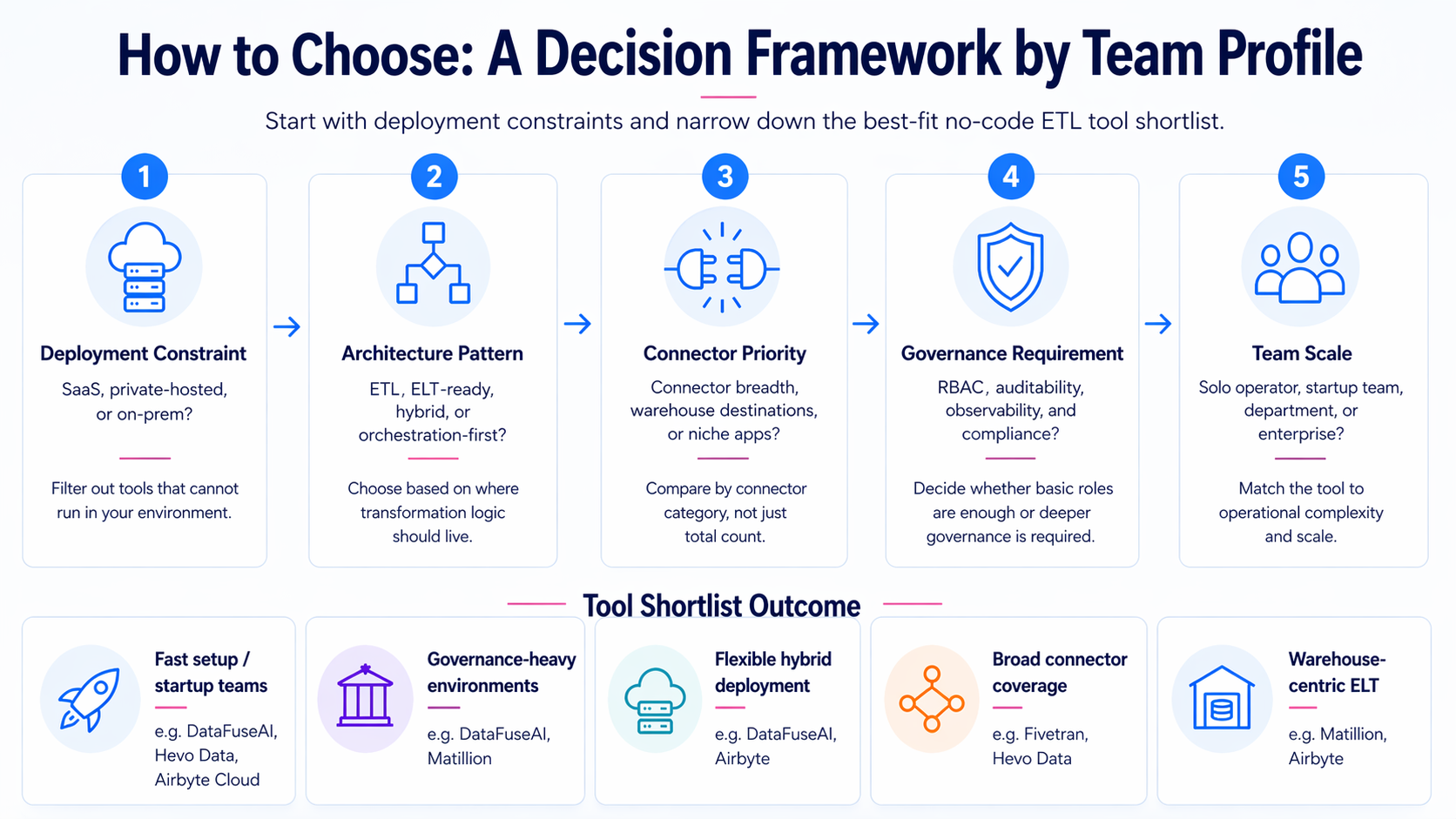
Answer the five questions below in sequence. Each answer either narrows your shortlist or routes you to specific tools, before you spend evaluation time on features that won't matter if the deployment model is wrong.
Deployment Constraint (the first filter)
Three tools have no on-premise path. Discover this now, not after shortlisting.
| Your environment | What this means | Routes to |
|---|---|---|
| Cloud is fine — no data residency, sovereignty, or compliance constraints | Standard SaaS deployment is acceptable | Continue to Step 2 |
| Compliance requires private-hosted or private cloud | Cloud-managed SaaS is not acceptable | DataFuseAI (Private-Hosted, GA), Matillion Enterprise (verify availability), IBM DataStage |
| Compliance requires zero external internet connectivity | No cloud, no internet, no external connections | DataFuseAI (On-Premise Offline, GA) — no other tool in this comparison supports this |
Architecture Pattern
ETL vs ELT is an architectural decision — it determines where transformation logic accumulates.
| Your destination and transformation preference | Routes to |
|---|---|
| Cloud warehouse (Snowflake, BigQuery, Redshift) — warehouse-native ELT | DataFuseAI (ELT in beta — note timeline), Fivetran, Airbyte, Matillion, Hevo Data |
| Relational databases, on-premise destinations, or controlled pre-load transformation required | DataFuseAI (ETL in production), Integrate.io |
| Both ETL and ELT in the same environment | Integrate.io (ETL + ELT + CDC), Hevo Data (ETL + ELT) |
Teams evaluating DataFuseAI for ELT-based cloud warehouse pipelines should note that ELT is currently in beta. Teams requiring pushdown ELT in production today should use Fivetran, Airbyte, or Matillion at this step.
Connector Priority
Compare by connector category, not just total count.
| Your primary sources | Routes to |
|---|---|
| SaaS applications (Salesforce, HubSpot, Marketo, Stripe, ad platforms) | Fivetran (500–700+), Airbyte (550–600+), Hevo Data (150+), Integrate.io (200+) |
| Relational databases, NoSQL, AWS RDS variants, Azure cloud databases | DataFuseAI (50+ with 25 dedicated RDBMS variants — deepest dedicated database coverage in this comparison), Integrate.io |
| Mixed — both SaaS apps and databases | Integrate.io (200+ across categories), Airbyte |
Governance Requirement
Role labels vs action-level scope — meaningfully different under GDPR, HIPAA, and SOX.
| Your governance need | Routes to |
|---|---|
| Standard role-based access control is sufficient | Any tool in current shortlist |
| Action-level RBAC + complete audit trail (GDPR,[2] HIPAA,[3] SOX applicable) | DataFuseAI (action-level confirmed); action-level depth for Integrate.io and Matillion Enterprise not confirmed — verify directly |
| No specific governance requirement at this stage | Skip to Step 5 |
Team Scale and Monitoring Depth
Match the tool's operational complexity to your team's capacity to run it.
| Team profile | Routes to |
|---|---|
| Small team (1–5 people), SaaS pipelines, no compliance constraints | Hevo Data, Airbyte Cloud, Skyvia |
| Mid-market (5–20 people), database-centric sources, some governance requirements | DataFuseAI, Integrate.io, Fivetran |
| Enterprise (20+ people), compliance obligations, both scale and governance required | DataFuseAI (on-prem/private-hosted + action-level governance + 60M+ row benchmark[5]), Fivetran (SaaS breadth + scale, no on-prem), Matillion (warehouse-native scale) |
Most teams land in Step 2 or 3 — cloud-acceptable, connector-count-first. The compliance branch at Step 1 routes a smaller set of teams to a much shorter list. For any team where deployment control, audit trail completeness, or governance architecture is a regulatory requirement rather than a preference, the shortlist narrows to one or two tools, and connector count becomes a secondary consideration.
Where DataFuseAI Fits in This Comparison
DataFuseAI is the right choice when deployment constraint, audit trail completeness, or database-centric connectivity is the deciding criterion. It's the wrong choice when total connector breadth, warehouse-native ELT in production today, or broad SaaS app coverage is the deciding criterion.
Where DataFuseAI leads in this comparison:
- Three deployment models, all GA. Managed Cloud SaaS, Private-Hosted, and On-Premise Offline with no external internet. Among the six tools evaluated here, only DataFuseAI offers a confirmed, generally available fully offline deployment option — a hard requirement for government contractors, defense-adjacent teams, and healthcare organizations with zero-egress mandates.
- Action-level RBAC and full execution audit logging. Permissions are scoped to specific operations: running queries, starting or stopping clusters, creating drivers, editing pipelines, deleting logs, managing jobs. Audit logs capture user, action, and configuration state at execution time.[7] This addresses the legal requirements under GDPR Article 32[2] and HIPAA 45 C.F.R. § 164.312(b).[3]
- 25 dedicated RDBMS connectors. More individual relational database type coverage than any other tool in this comparison, including MSSQL, Oracle, PostgreSQL, MySQL, Snowflake, Redshift, SAP HANA, Vertica, Teradata, MonetDB, CockroachDB, MariaDB, IBM DB2, major RDS variants, and Azure SQL variants.
- Publicly documented scale benchmark. 60M+ rows per pipeline run[5] (75M combined dataset) in Databricks-backed benchmark testing. No other tool in this comparison has published a comparable per-run benchmark.
- Failure pattern detection across the last 5 execution cycles. System metrics (CPU, memory, disk) collected at 10-second intervals. Email alerts on scheduled job failure. Pipeline health aggregated at dashboard level.
- Engine flexibility without lock-in. Databricks, Apache Livy, and DataFuseAI's native engine.[6] Scale ceiling is compute-engine-dependent, not a platform-level cap.
Where DataFuseAI currently trails:
- ELT is in beta, not GA. Teams whose primary destination is a cloud warehouse and whose workflows require warehouse-native transformation in production today should use Fivetran, Airbyte, or Matillion rather than waiting.
- Total connector count (50+) is lower than Airbyte (550–600+), Fivetran (500–700+), and Integrate.io (200+). Teams requiring Salesforce, HubSpot, Marketo, Stripe, Kafka, or Kinesis connectors currently need custom driver development or a different platform.
- GCP coverage is BigQuery only. Cloud SQL, Pub/Sub, Spanner, and other GCP services are not natively supported.
- Batch-optimized. DataFuseAI is built for structured, scheduled batch ETL. Teams requiring real-time or streaming pipelines should evaluate streaming-native tools.
The Right Filter, Applied First
Picking a no-code ETL tool from a generic list sorted by connector count doesn't work because the right tool depends on constraints most lists don't evaluate. Start with deployment model: three of the six tools in this comparison have no on-premise path, and finding that out after shortlisting costs real time. From there, architecture determines which pipelines the tool can actually serve. Connector scope by category shows whether the sources you actually use are covered. Governance depth tells you whether the platform meets compliance obligations you're already under.
For database-centric, compliance-driven, or deployment-constrained teams: reach out to DataFuseAI or start with a free trial. For teams with primarily SaaS sources heading into a cloud warehouse: Fivetran or Airbyte are the more appropriate starting points based on this comparison.
 Request a Demo