

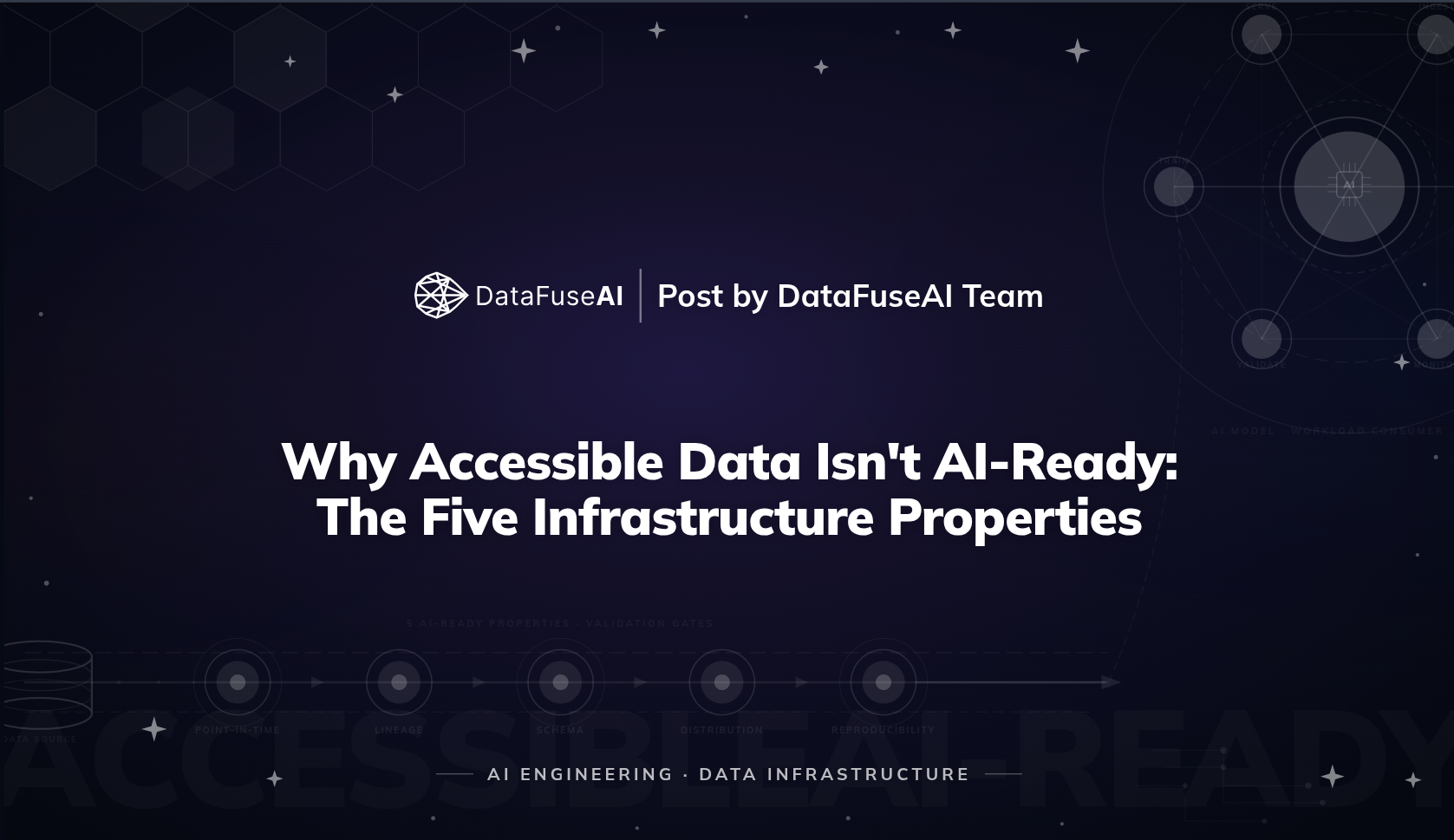
AI-ready data infrastructure is pipeline and storage architecture that satisfies the specific requirements of machine learning workloads: point-in-time correctness, documented lineage, schema stability, statistical representativeness, and reproducibility. Accessible data — data that is queryable and producing accurate reports — does not automatically meet these requirements. The gap between accessible and AI-ready is where most production AI initiatives stall, and it rarely shows up in the data quality reports that preceded the initiative.
The scenario has a recognizable pattern. A leadership team decides to build a predictive model — churn prediction, demand forecasting, fraud detection. The data team is asked whether the data is ready. The answer comes back: three years of clean transactional data in the warehouse, passed quality review, feeding daily dashboards without issue. Six months later, the model is in testing and producing unreliable results. Not because the data was inaccurate. Not because engineers made errors. Because the infrastructure designed for BI was never designed for AI, and those two use cases diverge in ways that don't show up in any BI-oriented quality check.
Five properties mark the structural difference. Each is precise, each is testable, and each has a documented failure mode when absent.
Accessible Isn't the Same as AI-Ready
AI-ready data infrastructure satisfies the requirements of both training workloads — where models consume historical data in bulk and must trust its temporal accuracy and statistical representativeness — and serving workloads, where models encounter live or batch records and must find the same schema, encoding, and distribution assumptions they trained on. Accessible data satisfies neither requirement by design. It satisfies a different requirement: producing accurate aggregated results for human review.
A dashboard consumer tolerates minor schema changes, corrected historical values, and data that's two hours stale. The aggregation absorbs the variation; a human reviewer adjusts the interpretation. A machine learning model cannot absorb any of those conditions without consequences. A schema change changes the feature vector. Corrected historical values change what the model learns was true at a given moment in time. Stale data changes the temporal relationship between inputs and the target variable being predicted.
In a 2015 paper published at NeurIPS, researchers at Google documented that in production ML systems, data pipeline components — not model code — constitute the dominant source of technical debt, with unstable data dependencies identified as the primary mechanism through which ML systems degrade over time.[1] The engineering community absorbed this as an ML engineering problem. It is more accurately an infrastructure design problem: the pipelines weren't built wrong — they were built for BI, and then expected to serve AI without modification.
A detailed treatment of what AI models actually need from your data pipeline covers the model-side requirements: feature formats, latency constraints, inference inputs. This piece addresses the infrastructure side — what your pipeline and storage architecture must do differently when AI is the consumer, not a dashboard.
Why BI Infrastructure Falls Short for AI Workloads
BI and AI workloads draw from the same data sources but make different demands on everything between source and consumer. Most data pipelines are built around assumptions that are correct for BI and wrong for AI. The gap isn't a quality failure — it's a design mismatch that becomes visible only when a model tries to train or serve against data that was structured for a different kind of consumer.
| Dimension | BI Pipeline Design | AI Pipeline Requirement |
|---|---|---|
| Temporal consistency | Historical values updated when corrections arrive; slowly changing dimensions reflect current state for accurate reporting | Point-in-time correct records only — each historical observation must reflect what was known at the moment of the event, not after correction |
| Schema change handling | Schema changes discovered when dashboards break; updated reactively by revising queries or dashboard configurations | Schema drift detected automatically before it reaches model inputs; changes trigger alerts and controlled propagation, not reactive fixes |
| Distribution monitoring | Not required; queries return whatever the data contains; anomalies noticed by human reviewers during analysis | Required at training time and serving time; deviations from the training distribution degrade model predictions silently, before any business metric reflects the problem |
| Reproducibility | Not required; running the same report on different days appropriately returns different results as data is updated | Required; the same training pipeline run on the same date range must produce identical output datasets for model debugging to be structurally possible |
| Lineage depth | Pipeline-level lineage sufficient for governance; knowing which source feeds which report is adequate for audit and understanding | Transformation-level lineage required; which source fields derived which features, using which logic, at which specific pipeline execution, to trace model behavior to data inputs |
None of these gaps represent poor BI engineering. BI pipelines are built correctly for their purpose. The problem is treating them as AI-ready by assumption, without verifying whether the design assumptions that serve dashboards also hold for model training and inference.
The NIST AI Risk Management Framework identifies data provenance documentation and quality management as core requirements under both the GOVERN and MAP functions — requirements that apply before any model is trained, not after deployment.[2] A BI-designed pipeline that lacks transformation-level lineage and output reproducibility cannot satisfy those requirements, regardless of how well it serves its reporting workloads.
The Five Properties That Make Data AI-Ready
Each property below has a precise definition, a specific failure mode when absent, and a connection to how machine learning models behave in production. They are ordered from most technically distinctive — properties that BI practitioners are unlikely to have encountered — to most governance-oriented, where regulators are now explicitly creating requirements.
Property 1: Point-in-Time Correctness
Point-in-time correctness means that for any historical record in a training dataset, the data reflects what was known at the moment of the event — not what was known later, after corrections, reversals, or updates. BI infrastructure routinely updates historical records when corrections arrive, which is correct behavior for reporting accuracy. Training data that incorporates corrected history creates a model that learns to predict using information that wasn't actually available at prediction time.
This is a structural form of data leakage: not an error in the data, but an error in when the data reflects. The failure mode is artificially strong training and validation metrics — because the model has access to future corrections during training — followed by degraded production performance where those corrections haven't yet occurred at inference time. The cause is invisible in a standard quality check because the corrected data is accurate; the problem is temporal, not factual.
Enforcing point-in-time correctness requires preservation of original record states. Corrections create new records with effective timestamps rather than overwriting historical values. The training pipeline reads the state of each record as it existed at the observation timestamp, not the current corrected state. This is a pipeline configuration requirement, not a data warehouse architectural change.
Property 2: Documented Lineage
Lineage at the pipeline level tells you where data came from. AI workloads require lineage at the transformation level: which source fields fed which derived features, using which transformation logic, at which specific pipeline execution. The NIST AI Risk Management Framework explicitly names data provenance documentation as a governance requirement under both the GOVERN and MAP functions — not as a best practice but as a baseline expectation for responsible AI development.[2]
The failure mode for absent transformation-level lineage isn't a broken pipeline — it's an investigation that cannot complete. When a model begins producing incorrect predictions in production, the diagnosis requires isolating whether the underlying data changed, the transformation logic changed, or the model's input distribution changed. Without execution-level lineage that captures config state at each run, none of those questions can be answered without manual reconstruction from git history, Slack threads, and analyst memory. For data governance and compliance requirements that extend beyond reporting workloads, transformation-level lineage is the mechanism that makes AI accountability traceable rather than aspirational.
Property 3: Schema Stability
Schema stability doesn't mean schemas never change. It means schema changes are detected before they reach model inputs, and changes are documented explicitly rather than discovered reactively when something breaks downstream. For BI consumers, a dashboard that breaks due to a renamed column is discovered and fixed manually. For an AI serving pipeline, a column rename that changes the feature a model expects causes silent misprediction — the pipeline continues running, the model continues producing predictions, and performance degrades gradually without a visible error signal in any pipeline log.
The EU AI Act's Article 10 requires that training, validation, and testing datasets for high-risk AI systems meet documented data governance and management practices.[3] Schema drift detection — automated comparison of incoming schema against the expected schema at each pipeline run, with alerting before downstream consumers receive changed data — is the operational mechanism that satisfies this requirement. It doesn't prevent schema changes; it ensures they are controlled rather than silent.
On the EU AI Act's scope: Article 10 applies specifically to high-risk AI systems as defined in Annex III of Regulation (EU) 2024/1689 — including AI used in employment decisions, creditworthiness assessment, biometric identification, and critical infrastructure management. Organizations outside the EU that serve EU persons or deploy in EU-regulated sectors should review which classification applies to their specific systems.
Property 4: Statistical Representativeness
A model trained on data that doesn't reflect the distribution it will encounter in production produces predictions calibrated to the training distribution, not the production distribution. This is independent of data quality in the conventional sense: training data can be perfectly accurate, perfectly clean, and completely governed — and still statistically unrepresentative of the use case it's intended to serve.
A 2021 systematic review in Nature Machine Intelligence examined 232 machine learning models developed for COVID-19 diagnosis and prognosis across multiple countries and research institutions. None were considered fit for clinical use. The primary causes identified were training datasets unrepresentative of the target patient population and labeling artifacts that introduced data leakage — not model architecture failures, not engineering errors by the model developers.[4] The data was not wrong. Its distribution did not match the population the models were built to serve.
Statistical representativeness must be validated before training and monitored in production as a serving-side property. Distribution drift — where incoming records shift away from the training distribution over time — degrades model predictions before the degradation appears in any business metric. This is what makes distribution monitoring an infrastructure requirement rather than a post-deployment concern that can be deferred until problems are noticed.
Property 5: Reproducibility
A non-reproducible training pipeline makes model debugging structurally impossible. If running the same pipeline twice on the same date range produces different output datasets — because of non-deterministic source queries, schema changes without versioning, or undocumented intermediate transformations — you cannot isolate whether a model failure traces to a data change or a model change. The data is different every time, so there is no stable baseline to compare against.
ISO/IEC 42001:2023, the first international AI management system standard, requires documented processes for data preparation and records of transformations applied specifically to enable traceability of AI system behavior to data inputs.[5] Reproducibility is how that traceability becomes real rather than theoretical: a pipeline that produces different outputs on different runs cannot satisfy a traceability requirement because the inputs are never stable enough to constitute a traceable record. Dataset versioning — tying each training output to a specific pipeline execution ID, row count, and schema snapshot — is the mechanism that closes this gap.
For data quality and transformation practices that enforce these properties at the pipeline configuration level, the implementation specifics vary by source system architecture and downstream model consumption patterns — but the five properties are consistent requirements regardless of stack.
The Training Path and the Serving Path Are Not the Same Problem
Training/serving skew is the most common silent failure mode in production AI. It occurs when the data a model trains on differs from the data it encounters at inference time — in schema, distribution, encoding, or temporal scope. The underlying cause is usually not an ML engineering error. It's an infrastructure assumption: that one pipeline design serves both workloads. It doesn't.
Training requires historical bulk reads with temporal guarantees. The training pipeline reads a snapshot of historical data across a defined time window. For that snapshot to produce a model that generalizes to production, it needs point-in-time correctness so the model learns from what was actually known at each historical moment, representativeness of the distribution the model will encounter at inference, and identical outputs across repeated runs so that retraining is comparable to the original. Getting any of these wrong during training creates a model that misbehaves in ways that training metrics don't reveal — because those metrics reflect how well the model fits the training data, not how well it will perform on production data.
Serving requires schema-stable, distribution-tracked live reads. Each incoming record must arrive with the same schema the model trained on, and the distribution of those records must stay within the bounds the model was calibrated to handle. Serving failures are more visible than training failures — predictions go wrong, users notice — but diagnosing them requires the lineage records from execution logging to separate a data infrastructure change from a model issue.
Consider a demand forecasting model trained on 18 months of historical sales data. Three months after deployment, the model begins systematically underforecasting a product category. Investigation eventually reveals that a supplier code field in the source system was renamed six weeks earlier. The BI dashboard was updated and the change was noted in a release document. The serving pipeline had been delivering records with an empty feature for six weeks — the model was producing predictions against structurally different inputs than it trained on, and nothing in the pipeline's error logs reflected the problem because the pipeline completed successfully at every run.
This scenario is not a fringe case. It is the standard consequence of applying one pipeline design to two workloads with genuinely different requirements. Formalizing the mental model of training path and serving path — even when they share underlying infrastructure — is the first architectural decision an AI-ready data infrastructure must make. For pipeline automation that supports distinct operational requirements for different downstream consumers, the pipeline configuration must encode those differences explicitly.
Training data and serving data have different requirements. Acknowledging that distinction is not an engineering preference. It's the structural decision that determines whether your AI initiative can diagnose its own failures.
What Building AI-Ready Infrastructure Actually Requires
None of the five properties require replacing your existing pipeline. Each requires specific configuration changes that add observable, documented behavior to what's already running. Four changes cover the structural gap between a BI-designed pipeline and one that can reliably support AI workloads.
Execution logging with config-state capture is the foundation. Every pipeline run must record not just success or failure, but what configuration it ran with: which source tables were read, which transformation logic was applied, what the output row count and schema were at completion. This is the mechanism that satisfies both the reproducibility requirement (Property 5) and the transformation-level lineage requirement (Property 2). Without it, diagnosing a model failure that traces to a data change is reconstruction from memory and git history. With it, the investigation is a query against a log that was written at execution time.
DataFuseAI's full execution audit logging captures user, action, and configuration state at each pipeline run. That record — who triggered the pipeline, what configuration was active, what the output contained — is precisely what both ISO/IEC 42001 and the NIST AI RMF identify as the required documentation for responsible AI data governance.
Schema drift detection is the operational mechanism for Property 3. Schema changes that propagate silently to model inputs are the infrastructure cause of training/serving skew in most production environments. The implementation requires automated comparison of incoming schema against the expected schema registered at the last training run, with alerting before downstream consumers receive changed data. Not a manual audit process — an automated check that fires at every pipeline execution, before any model encounters the changed input.
Distribution monitoring addresses Properties 1, 4, and 5 in the serving context. After each training pipeline run, compare the distribution of key features against the baseline established at initial training. After each serving pipeline run, compare the distribution of incoming records against the training distribution. Deviations beyond configured thresholds indicate either data drift (the world has changed) or pipeline drift (the infrastructure has changed). Distinguishing between them requires the execution log from config-state capture. DataFuseAI's monitoring surfaces job failure history across the last five execution cycles, with 10-second system metrics and email alerts on scheduled job failure — the operational visibility layer that catches infrastructure changes before they propagate into silent model degradation. For data observability practices that extend these principles across longer time horizons and more complex pipeline graphs, the four changes described here are where the observability work begins.
Dataset versioning is the reproducibility mechanism. Training datasets must be versioned — not necessarily by storing multiple full copies of large datasets, but by maintaining a versioning scheme that ties each training run output to a specific pipeline execution ID, a row count, and a schema snapshot. This lets you confirm you are retraining on the same data you originally trained on, and lets investigators determine whether a model change or a data change caused a production failure, without relying on anyone's memory of what the pipeline was doing six weeks ago.
- Runs complete with no config-state record; configuration exists only in code or documentation
- Schema changes discovered when dashboards break; no automated detection before data reaches consumers
- No distribution baseline; each run starts fresh with no comparison against a training-time reference
- Training runs produce different output datasets on different days without any recorded explanation
- Transformation logic lives in analyst memory, undocumented SQL, or a Confluence page last updated by someone who left
- Each run captures user, action, and full configuration state in an immutable execution audit log
- Schema drift detection fires before downstream model inputs receive changed data; changes trigger controlled review
- Distribution of key features compared against training baseline at every serving pipeline run
- Training datasets versioned with pipeline execution ID, output row count, and schema snapshot
- Transformation logic version-controlled; config state captured at each execution, traceable to specific model versions
For regulated industries — healthcare, financial services, government — these four changes are not optional engineering improvements. The EU AI Act requires documented data governance for high-risk AI systems. ISO/IEC 42001 requires records of transformations applied. The NIST AI RMF requires data provenance documentation throughout the AI lifecycle. The compliance work and the infrastructure work are the same work: the same execution logging that satisfies an ISO 42001 audit requirement is also the mechanism that lets you debug a production model failure in hours rather than days.
Frequently Asked Questions
AI-ready data infrastructure is pipeline and storage architecture that satisfies the specific requirements of machine learning workloads — both training and serving. The five defining properties are: point-in-time correctness, documented lineage, schema stability, statistical representativeness, and reproducibility.
A pipeline that produces accurate BI reports may fail all five properties without producing any visible errors in the BI layer. The failures only surface when a model tries to train against the data or serve predictions against it — often weeks or months after the infrastructure gap was introduced.
Not necessarily a physically separate system, but the two workloads require different operational guarantees from whatever infrastructure they share. Training pipelines need point-in-time correctness, dataset versioning, and reproducibility. Serving pipelines need schema drift detection and distribution monitoring against the training baseline. Most organizations implement these as separate pipeline configurations feeding from the same governed source layer.
The decision to physically separate them depends on scale, team structure, and how different the operational requirements become in practice. What can't be deferred is formalizing that the two paths have different requirements — and ensuring the pipeline configuration reflects those differences explicitly rather than assuming one design serves both workloads adequately.
Training/serving skew occurs when the data a model trains on differs from the data it encounters at inference time — in schema, distribution, encoding, or temporal scope. The most common causes: a schema change in the source system reflected in the serving pipeline but not captured in the training snapshot; a feature computed differently in training versus serving due to undocumented transformation logic; or temporal inconsistency where training data includes corrected historical values that don't exist yet in real-time serving.
The failure mode is characteristically silent. The pipeline continues running without errors. The model continues producing predictions. Performance degrades gradually — sometimes over weeks — before anyone connects the degradation to an infrastructure change. Schema drift detection and execution-level audit logging are the two infrastructure properties that make the cause identifiable before the degradation reaches a visible business threshold.
Yes — the warehouse data itself is not the structural problem. The pipeline that reads from the warehouse for AI training needs targeted changes: enforce point-in-time correctness by reading historical record states rather than current corrected states; produce reproducible output datasets versioned with a pipeline execution ID and row count; capture the schema and distribution of data at each training run so that future retraining can be validated against a stable baseline.
None of these require modifying the warehouse. They require modifying how the training pipeline reads from it, what it records about each run, and how it versions its outputs. The BI pipelines reading from the same warehouse continue unchanged. The infrastructure changes are additive, not replacement.
 Request a Demo