
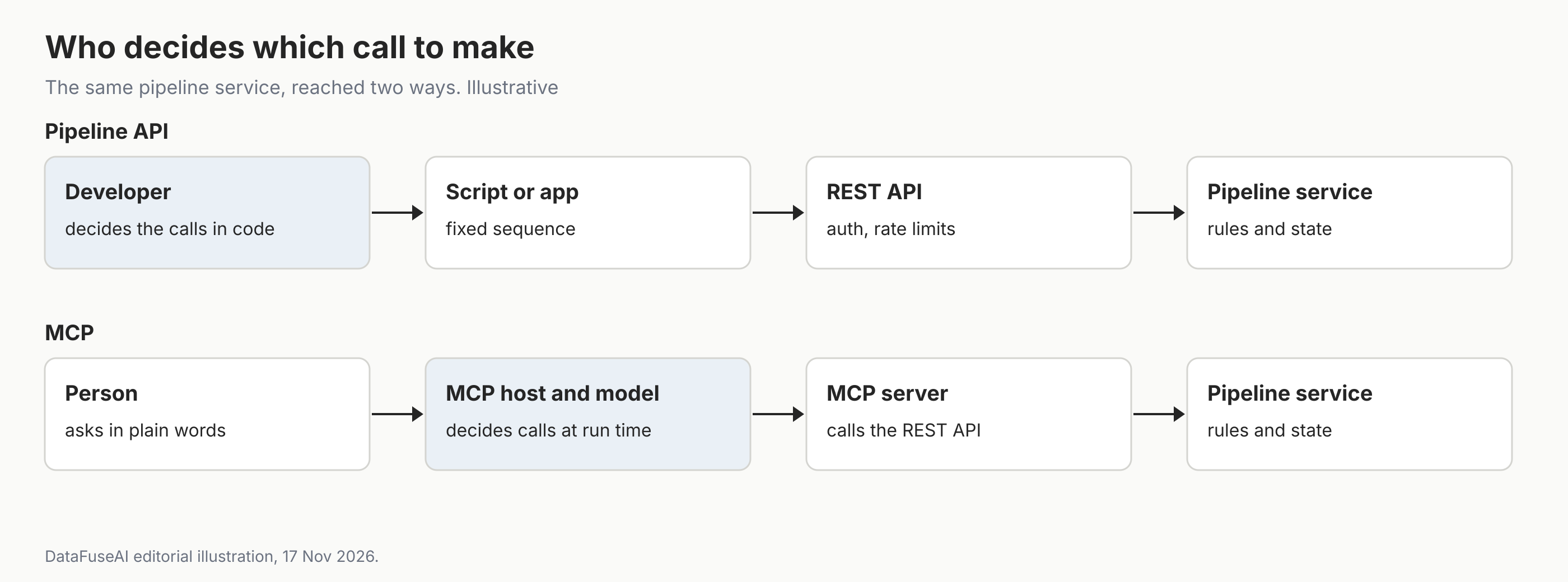
MCP vs API comes down to who decides each call: code a developer wrote in advance, or an AI assistant choosing tools at run time [1]. That is the main thing an MCP server changes when your pipeline platform already has a REST API. The two MCP servers we examined both sit on top of their product's existing REST API.
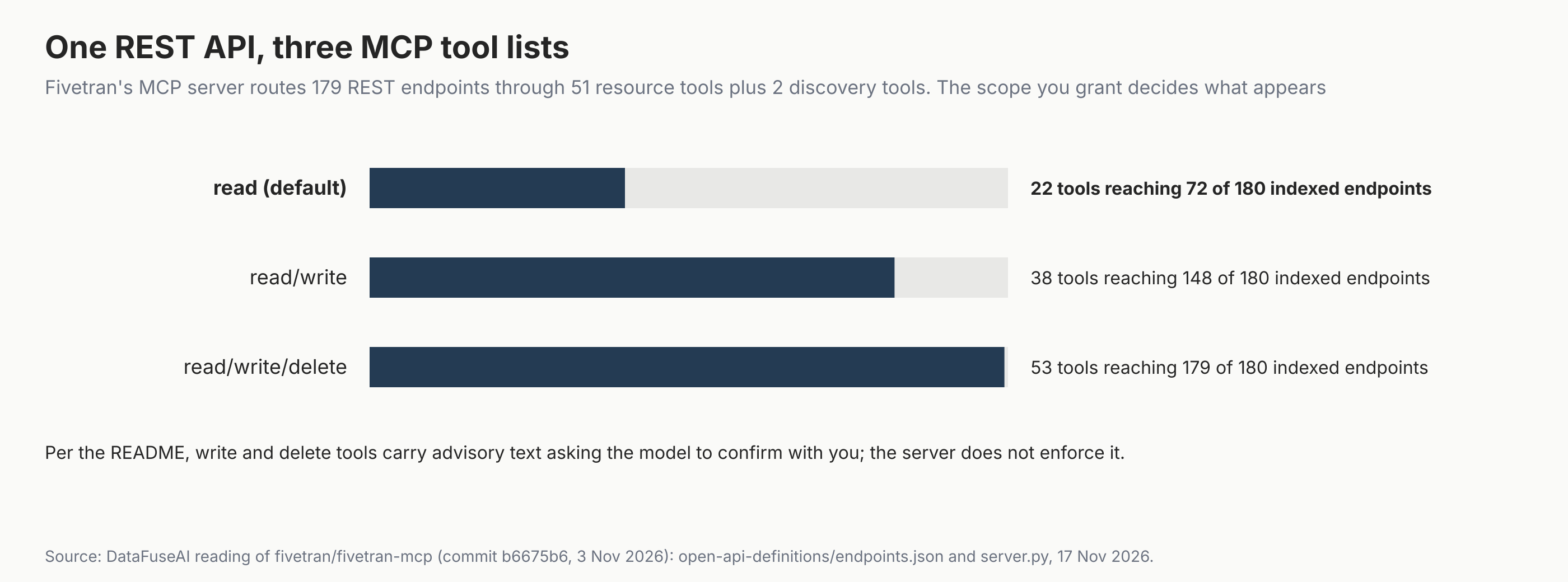
Fivetran's server shows the relationship. By our count of its endpoint index and server code, it routes 179 of its REST endpoints through 51 resource tools plus two discovery tools [2]. In its default read scope, with no denylist set, an assistant sees 22 tools. What changes for the user is who decides each call. What must not change is the rules the API already enforces.
Figures checked 17 November 2026. This guide is for data engineers and platform owners deciding whether to connect assistants to their pipelines through MCP, an API, or both. It describes the MCP specification version 2026-07-28 [3].
Key Takeaways
- MCP can wrap the API you have. Fivetran's server routes REST endpoints, and Astronomer's Airflow server describes itself as access to Airflow's REST API.
- The caller changes. With an API, a developer fixes the call sequence; with MCP, the model chooses it from the tool list.
- Discovery happens at run time. An MCP client asks the server for its tools instead of reading documentation.
- Tool errors can reach the model. Tool execution errors return as results the client should pass to the model; protocol errors come back as JSON-RPC errors that clients may or may not show it.
- Rules must stay in the service. Fivetran's README says its confirmation text is advisory and not enforced by the server.
What is the difference between MCP and an API?
An API is a contract between programs: endpoints, inputs, outputs and errors, called by code a developer wrote. MCP is a protocol that lets an AI application connect to servers that describe their own tools, resources and prompts [3]. The model decides which tool to call, the client sends the request, and the server runs the tool [1].
In the 2026-07-28 version, each request is stateless and self-contained [3]. A server's tool list may vary with the authorization on the request but must not vary per connection [1]. That brings MCP closer to how a REST API already works: each call carries its own credentials, and the service decides what that caller may do.
| Question | Pipeline API | MCP |
|---|---|---|
| Who decides which call to make? | A developer, in code | The model, from the tool list |
| How does the caller learn what exists? | Documentation, read in advance | The tools/list request at run time [1] |
| How are inputs described? | An API schema, often OpenAPI | A JSON Schema per tool [1] |
| Where do errors go? | To the calling program | Tool execution errors return as results the client should give the model; protocol errors stay JSON-RPC errors [1] |
| Who confirms risky actions? | Whatever the program does | The host should prompt for confirmation [1] |
| What enforces permissions? | The service behind the API | The server and the service behind it, if built that way |
Editorial comparison by DataFuseAI, 17 November 2026, based on the specification cited.
How does an MCP server relate to an existing API?
In both servers we examined, the MCP server is a layer on top of the existing REST API. Fivetran's server reads an index of its REST endpoints and groups them into tools by resource and action, such as connections read or connections write [4]. Astronomer's Airflow server says it gives AI assistants access to Airflow's REST API [5].
| Scope granted | Tools listed | REST endpoints reachable |
|---|---|---|
| read (default) | 22 | 72 |
| read/write | 38 | 148 |
| read/write/delete | 53 | 179 |
Source: fivetran/fivetran-mcp, commit b6675b6 of 3 November 2026: endpoints index and server code, read 17 November 2026. No denylist set. One deprecated endpoint is not routed.
Fivetran's README warns that even read scope reaches API-key endpoints unless you set its recommended denylist [4]. With that denylist, our count falls to 21, 36 and 50 tools, reaching 68, 139 and 168 endpoints.
By our count, the endpoint index lists 180 endpoints: 72 read, 77 write and 31 delete [2]. Grouping them means the assistant chooses a resource tool, then an endpoint within it, after asking the server for its schema [4]. The server configuration can also deny single endpoints, such as one sync operation, inside a granted scope [4].
What changes for the user?
Three things change. The user describes an outcome instead of writing calls, so the model's choices need review. Discovery moves from documentation to the server, so the tool list becomes the contract. And confirmation moves to the MCP host, which the platform does not control.
The specification's key principles say hosts must obtain explicit user consent before invoking any tool [3]. Its tools page adds that there should always be a human able to deny tool calls, and that clients should prompt for confirmation on sensitive operations [1]. Fivetran's server adds advisory confirmation text to write and delete tools, and its README says the server does not enforce confirmation [4]. The specification itself notes that MCP cannot enforce its security principles at the protocol level [3]. So a rule that must hold belongs in the service, not in a prompt.
What should stay the same?
A pipeline service should keep everything its API already enforces. Permissions, validation, rate limits, audit and run history should apply whether a call comes from a script or an assistant. The specification requires servers to validate tool inputs, apply access controls and rate limits, and sanitise outputs [1].
The service should also be able to tell callers apart. If an audit log records that a change came through MCP, a reviewer can find every assistant-made change later. If the MCP server shares one service account for every user, per-user permissions are lost. Our guide to audit-ready data operations covers what such a log should record.
Both servers we examined show ways to keep the service in charge. Fivetran's server names its transport and the AI client in the User-Agent of every Fivetran API call, so the API side can tell MCP traffic apart [6]. Its HTTP mode takes each caller's own Fivetran key and refuses to start if a shared key is set, because one operator's credentials would apply to every caller [4]. Astronomer's read-only setting blocks writes at the MCP server regardless of token permissions, and its open-source Airflow plugin inherits Airflow's own role-based access control [5].
For what to watch in run history, see DataFuseAI's guide to data observability for pipelines.
When should you use MCP, an API, or both?
Use the API for fixed, repeated jobs a developer can write and test. Use MCP for work a person directs in plain language, especially across several tools. Many teams will use both, on the same service.
| Situation | Better fit | Why |
|---|---|---|
| A nightly job with known steps | API | Fixed sequence, tested in code |
| CI checks on pipeline definitions | API | Repeatable and reviewable |
| An engineer exploring a failed run | MCP | Inspection tools chosen as the question changes |
| Drafting a new pipeline from a ticket | MCP | Combines context from several tools |
| Anything that deletes or publishes | Either, with review in the service | Neither path should skip approval |
Editorial guidance by DataFuseAI, 17 November 2026.
Mistakes to avoid
- Treating MCP as a separate permission system. It should call the same service with the same rules.
- Exposing every endpoint by default. Fivetran starts in read scope and recommends a denylist for credential endpoints; follow that pattern.
- Relying on confirmation text. A description asking the model to confirm is advice, not a control.
- Sharing one service account for all MCP users. Per-user permissions and audit disappear.
- Copying API error codes without words. A model needs the reason to correct a call.
Where DataFuseAI fits (and where it doesn't)
DataFuseAI is a data integration vendor. Here we describe the MCP protocol, Fivetran's and Astronomer's servers and a one-line version check with the public MCP Python SDK, not a DataFuseAI feature. We don't compare DataFuseAI's own API or tools with Fivetran's here.
DataFuseAI's product pages describe service-side controls of the kind this guide recommends. Its governance page describes permission groups set module by module and an audit log of who changed what, with old and new values [7]. Its pipeline automation page describes scheduled jobs that keep each run's duration, status and step log [8].
To test a pipeline workflow on your own data, DataFuseAI's free 30-day POC asks for one recurring workflow and two or three data sources [9]. Applications are reviewed for fit, there is no POC fee or obligation, and external cloud or compute costs, if any, stay with you [9].
Frequently Asked Questions
Does MCP replace a REST API?
No. In the two servers we examined, MCP sits on top of the product's existing REST API; Fivetran's server routes its REST endpoints through MCP tools. The API remains the right choice for fixed jobs that code runs on a schedule, while MCP suits work an assistant directs.
Is MCP less secure than an API?
Not by design. Both should reach the same service with the same permissions. The extra risk with MCP is that a model chooses the calls, so tools that change or delete things need service-side limits and review. Confirmation prompts in the host help but aren't guaranteed.
Do I need to write a new API to support MCP?
Not necessarily. An MCP server can map tools to the endpoints you already have, as Fivetran's does. You may still add tools that combine several calls or return clearer errors. Either way, the API keeps enforcing its own permissions, rate limits and validation, so the MCP server inherits those rules rather than replacing them.
Which MCP version should a pipeline platform target?
Check the specification's current version before you build. On 17 November 2026 the specification's versioning page named 2026-07-28 as current [10]. Then confirm that your SDK version supports it; the MCP Python SDK 2.3.0 reported 2026-07-28 as its latest protocol version in our test [11].
Methodology
Fivetran figures. Counted from open-api-definitions/endpoints.json and server.py in fivetran/fivetran-mcp at commit b6675b6 (3 November 2026), read on 17 November 2026. Tool counts per scope add the two discovery tools to the resource tools allowed by that scope. One deprecated endpoint is in the index but not routed. Counts were produced at 06:51 UTC. For the denylist figures we removed the README's recommended endpoints from each scope and recounted the tools that still had an endpoint left.
SDK check. We installed the public MCP Python SDK 2.3.0 in a clean environment and read its latest supported protocol version; it reported 2026-07-28. We did not build or run an MCP server for this article.
Other servers. Astronomer's description and read-only setting come from its README in astronomer/agents at commit 35b9610. Fivetran's User-Agent behaviour comes from its ARCHITECTURE.md at commit b6675b6. Specification statements come from version 2026-07-28 of the MCP specification, read on 17 November 2026.
Limits. We did not run Fivetran's server; counts come from its code and index. Tool counts describe what can be exposed, not what any user enables. The comparison tables are editorial.
References
- Model Context Protocol. "Tools" (specification version 2026-07-28). Accessed 17 November 2026. https://modelcontextprotocol.io/specification/2026-07-28/server/tools
- Fivetran. "fivetran/fivetran-mcp: open-api-definitions/endpoints.json" (commit b6675b6, 3 November 2026). Accessed 17 November 2026. https://github.com/fivetran/fivetran-mcp/blob/b6675b66a114ea378d8a9b2d77b6fdef155310c4/open-api-definitions/endpoints.json
- Model Context Protocol. "Specification" (version 2026-07-28). Accessed 17 November 2026. https://modelcontextprotocol.io/specification/2026-07-28
- Fivetran. "fivetran/fivetran-mcp: README" (commit b6675b6, 3 November 2026). Accessed 17 November 2026. https://github.com/fivetran/fivetran-mcp/blob/b6675b66a114ea378d8a9b2d77b6fdef155310c4/README.md
- Astronomer. "astronomer/agents: astro-airflow-mcp/README.md" (commit 35b9610, 29 October 2026). Accessed 17 November 2026. https://github.com/astronomer/agents/blob/35b9610bb2710c37ca11326c4cbf7818b6725fec/astro-airflow-mcp/README.md
- Fivetran. "fivetran/fivetran-mcp: ARCHITECTURE.md" (commit b6675b6, 3 November 2026). Accessed 17 November 2026. https://github.com/fivetran/fivetran-mcp/blob/b6675b66a114ea378d8a9b2d77b6fdef155310c4/ARCHITECTURE.md
- DataFuseAI. "Data Governance & Compliance: RBAC, Audit Logs, Isolation." Accessed 17 November 2026. https://www.datafuseai.com/solutions/data-governance-compliance
- DataFuseAI. "Data Pipeline Automation, Scheduling & Monitoring." Accessed 17 November 2026. https://www.datafuseai.com/solutions/data-pipeline-automation
- DataFuseAI. "Free 30-Day Data Integration POC." Accessed 17 November 2026. https://www.datafuseai.com/free-poc
- Model Context Protocol. "Versioning." Accessed 17 November 2026. https://modelcontextprotocol.io/specification/versioning
- Model Context Protocol. "Python SDK" (version 2.3.0). Accessed 17 November 2026. https://github.com/modelcontextprotocol/python-sdk
 Request a Demo