
Your customer match runs at 85 and the merge looks clean. Then support finds that Robert Smith in Chicago now shares a record with Robert Smith in Denver, while "Rob Smith" on the same Chicago phone number was never matched. A fuzzy matching threshold is the minimum similarity score, on a 0 to 100 scale [1], that two records need before a pipeline treats them as the same entity. Choose it from labelled pairs, one score band at a time, after you have decided which fields to score.
We tested that on 5,000 synthetic people whose true matches are known. Scoring the full name alone, a threshold of 85 paired 444 different people and missed 1,455 true matches. Scoring seven fields together, the same 85 paired nobody wrongly, and false matches stopped entirely from a score of 66.
Figures checked 16 November 2026. This guide is for data engineers and analysts who own a matching or deduplication step. For how edit distance and the 0 to 100 score are calculated, read fuzzy matching in ETL pipelines first.
Key Takeaways
- The threshold is the last decision, not the first. What you score (which fields, standardised how) moved false matches at 85 from 444 to 0 in our test.
- Names alone never reached zero false matches. At a perfect name score of 100, 243 pairs were still two different people with the same name.
- One typo costs a short name more points. One wrong letter in a four-letter name scores 75; in a ten-letter name it scores 90.
- Label pairs by score band, not at random. Twenty-five labelled pairs per five-point band located the boundary, once we added one band of margin.
- Use two thresholds. Merge above the upper one, review between, reject below. In our run, 158 pairs needed review, about 3 for every 100 people linked, and every false match was among them.
What does a fuzzy matching threshold decide?
A fuzzy matching threshold decides which scored pairs become matches. DataFuseAI's Fuzzy Filter and Fuzzy Join use Levenshtein distance, turned into a score with (1 − distance ÷ max length) × 100 [1]. A pair at or above the threshold is a match. Everything below it is treated as two different records.
Two kinds of error follow from that one number. A false match merges two different people, which a threshold set too low causes. A missed match leaves one person split across two records, which a threshold set too high causes. Record linkage researchers measure the first with precision and the second with recall. Hand and Christen argue that how much each matters belongs to the problem and the user, not to the matching method [2].
That is the real question behind "what threshold should I use". Matching is one step in a wider pipeline, covered in what a data integration platform does. Here the cost of each error decides the threshold. A missed match in a marketing list costs a duplicate email. A false match in a patient or billing system can send one person's data to another. Decide which error you can tolerate before you look at any score.
How we tested thresholds on 5,000 known matches
We used FEBRL 4, a public test set with 5,000 original records in one file and one corrupted duplicate of each in the other [3]. The Febrl generator creates duplicates by inserting, deleting, transposing and substituting characters, swapping in real spelling variants, blanking fields and swapping field values [4]. Because the data is generated, the true match for every record is known [4].
Comparing every record with every other gives 25 million pairs, so we first kept only pairs sharing a postcode, a date of birth or name initials. That left 51,802 candidate pairs, which contained 4,985 of the 5,000 true matches. We then scored each pair with DataFuseAI's published Levenshtein formula and swept the threshold from 50 to 100.
The test compared five ways of scoring the same pairs:
- Full name only: given name and surname as one string.
- Each name part separately: given name and surname must both pass, like an individual-score mode.
- Name plus date of birth: the mean of the two scores.
- Name plus postcode: the mean of the two scores.
- Seven-field mean: given name, surname, street number, street, suburb, postcode and date of birth, with a field left out when it is empty on either side.
The Methodology section lists what this test cannot tell you, starting with the fact that the people are synthetic.
Why does the same threshold give different results?
The same threshold produced between 0 and 444 false matches in our test, depending only on which fields were scored. At 85, scoring the full name alone found 3,545 of 5,000 true matches and created 444 false ones. The seven-field mean found 3,764 and created none.
| What you score | False matches at 80 | False matches at 85 | True matches found at 85 (of 5,000) | Lowest threshold with zero false matches |
|---|---|---|---|---|
| Full name only | 734 | 444 | 3,545 | None (243 remain at 100) |
| Given name and surname, each must pass | 393 | 302 | 2,796 | None (243 remain at 100) |
| Name plus postcode | 89 | 15 | 3,385 | None (1 remains at 100) |
| Name plus date of birth | 61 | 20 | 3,663 | None (6 remain at 100) |
| Seven-field mean | 0 | 0 | 3,764 | 66 (finds 4,878) |
Source: DataFuseAI threshold test on FEBRL 4, 16 November 2026. Counts are candidate pairs after blocking.
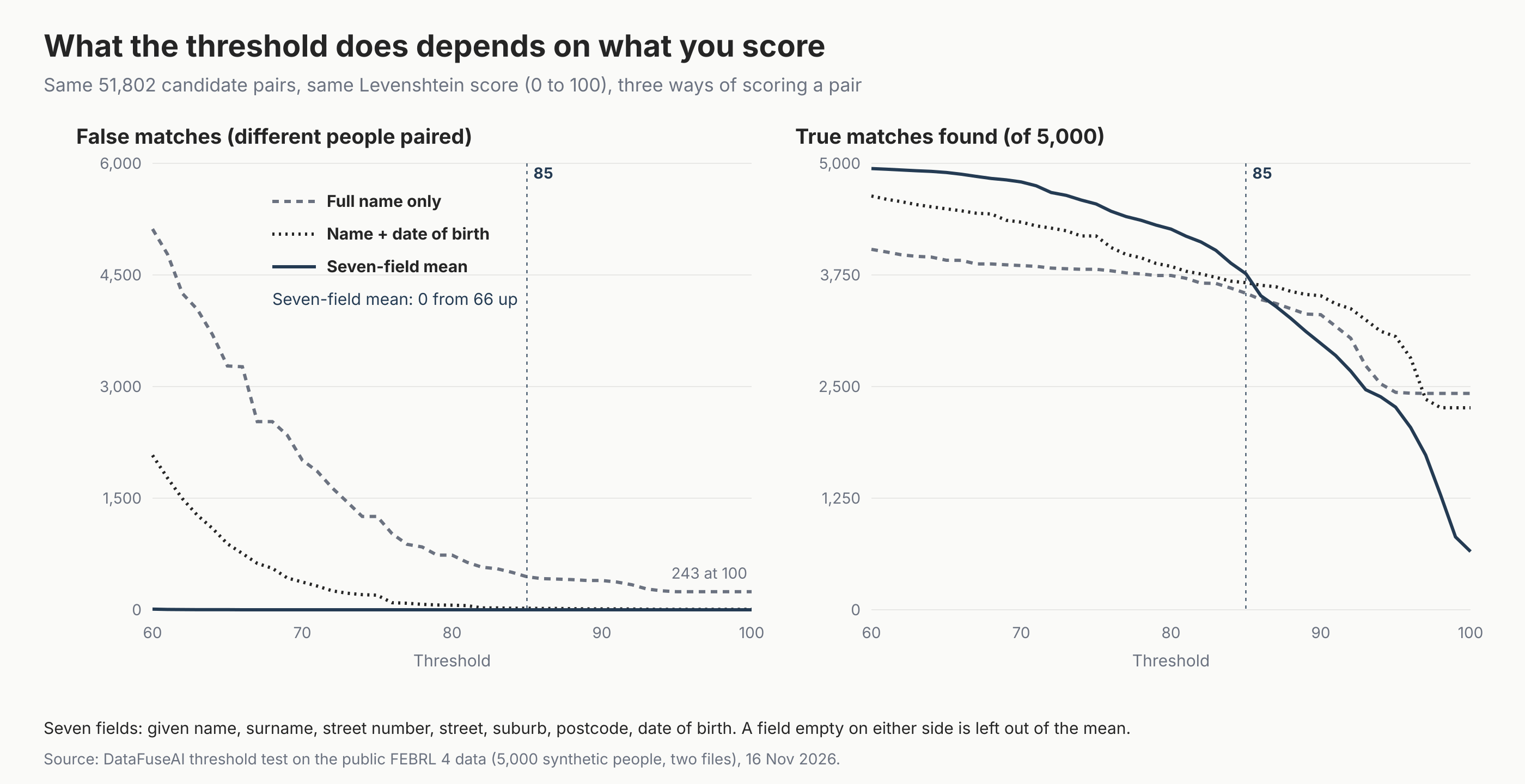
Requiring each name part to pass separately had the lowest recall here. Short given names lose many points to one typo, and an empty given name fails outright. The separate-parts rule found 749 fewer true matches at 85 than the full-name score, while cutting false ones only from 444 to 302.
Why can't a name score alone reach zero false matches?
A name score of 100 means the two strings are identical, not that the two records describe one person. In our test, 243 pairs scored a perfect 100 on the full name and were still two different people. Those pairs covered 129 distinct names, and 211 of them involved one of the 20 most common surnames in the first file.
No threshold can separate those pairs, because nothing in the name differs. Census record linkage methods can account for how often a specific name component occurs, with Smith among the examples [5]. In our data, that is exactly where the errors sat.
The running Robert Smith sample shows the same problem on a small scale. These scores use the same Levenshtein formula on illustrative sample records.
| Pair (illustrative sample) | Same person? | Name score as stored | After standardising | Phone matches? |
|---|---|---|---|---|
| Robert Smith / Rob Smith | Yes | 75.0 | 75.0 | Yes |
| Robert Smith / R. Smith | Yes | 58.3 | 58.3 | Yes |
| Robert Smith / SMITH, ROBERT | Yes | 7.7 | 100.0 | Yes |
| Robert Smith / Roberta Smith | No | 92.3 | 92.3 | No |
| Robert Smith (Chicago) / Robert Smith (Denver) | No | 100.0 | 100.0 | No |
Source: DataFuseAI scoring of the illustrative Robert Smith sample, 16 November 2026. Standardising means lower case, punctuation removed and "Last, First" reordered.
At 85, the names as stored get all five pairs wrong. Standardised, they still get four wrong: Roberta and the Denver Robert merge, while Rob and R. Smith are missed. The phone number gets all five right, which is the case for scoring a second field rather than tuning the first.
How do short names and empty fields move the score?
The same typo lowers a short name's score far more than a long one's, so one fixed threshold treats names unequally. Under DataFuseAI's formula, one wrong letter in a four-character name scores 75, in six characters 83.3 and in ten characters 90. At 85, any single typo in a name of six characters or fewer fails.
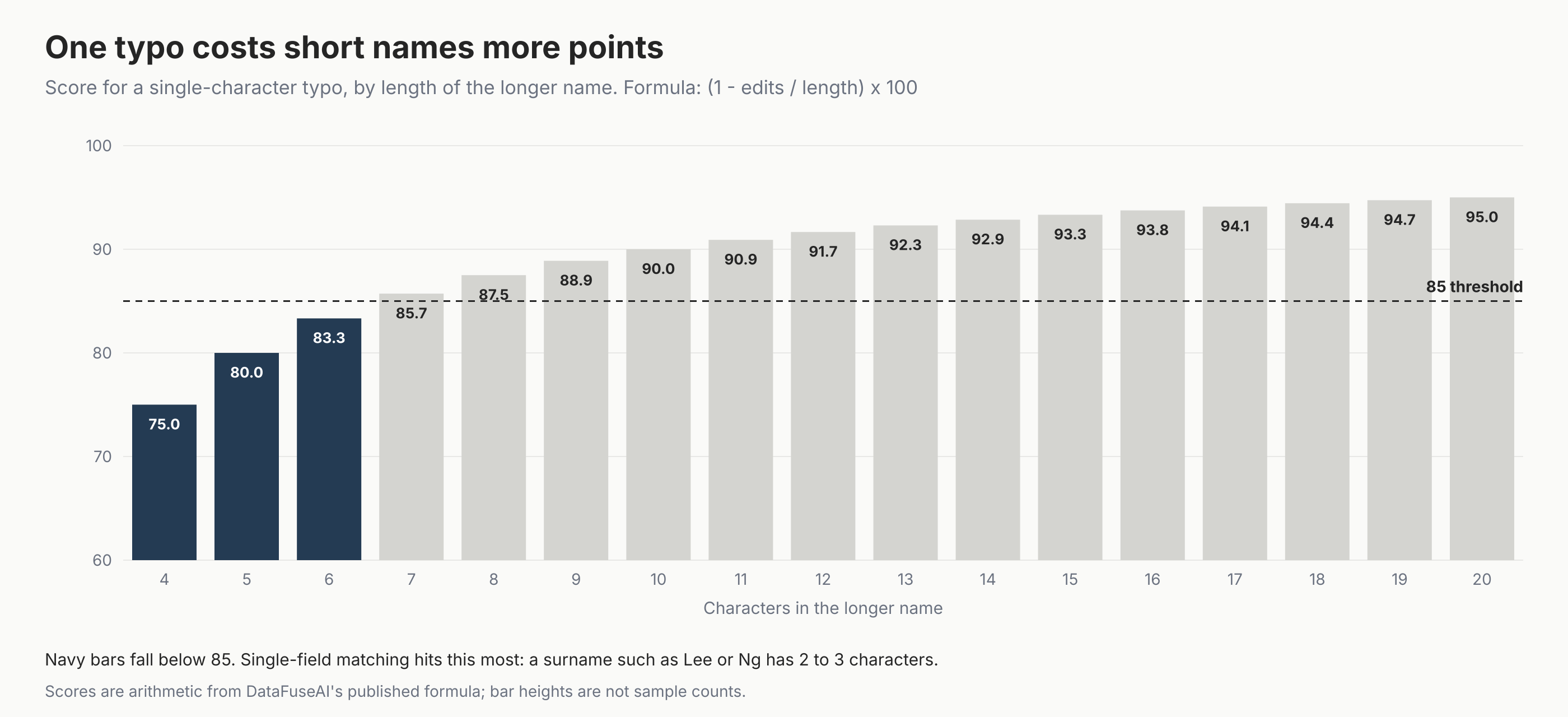
This matters most when you score single fields. A surname such as Lee or Ng has two or three characters, so one typo puts it far below any usual threshold. Scoring the full name, or several fields, spreads one typo across more characters.
Empty fields need a rule before you set any threshold. Of the 1,440 blocked true pairs that the full-name score missed at 85, 241 had an empty given name or surname on one side. In the seven-field mean, scoring an empty field as 0 instead of leaving it out cost 355 true matches at 85, where there were no false matches to remove. At 60, the same rule cut false matches from 9 to 1 and cost 32 true matches.
Plauti says its default of disregarding empty fields causes more false positives than anything else [6]. Our low-threshold result partly supports that, and our high-threshold result shows the price. In FEBRL the blanks were introduced into true duplicates, so penalising them mostly hurt. Test the rule on your own labelled pairs, at the thresholds you will actually use.
The five-step threshold test
The five-step threshold test is a DataFuseAI editorial framework, not an industry standard. Steps 1 and 2 change what the scores mean. Steps 3 to 5 choose the cut-offs from labelled evidence. The order matters, because standardising after you pick a threshold changes every score it was chosen from.
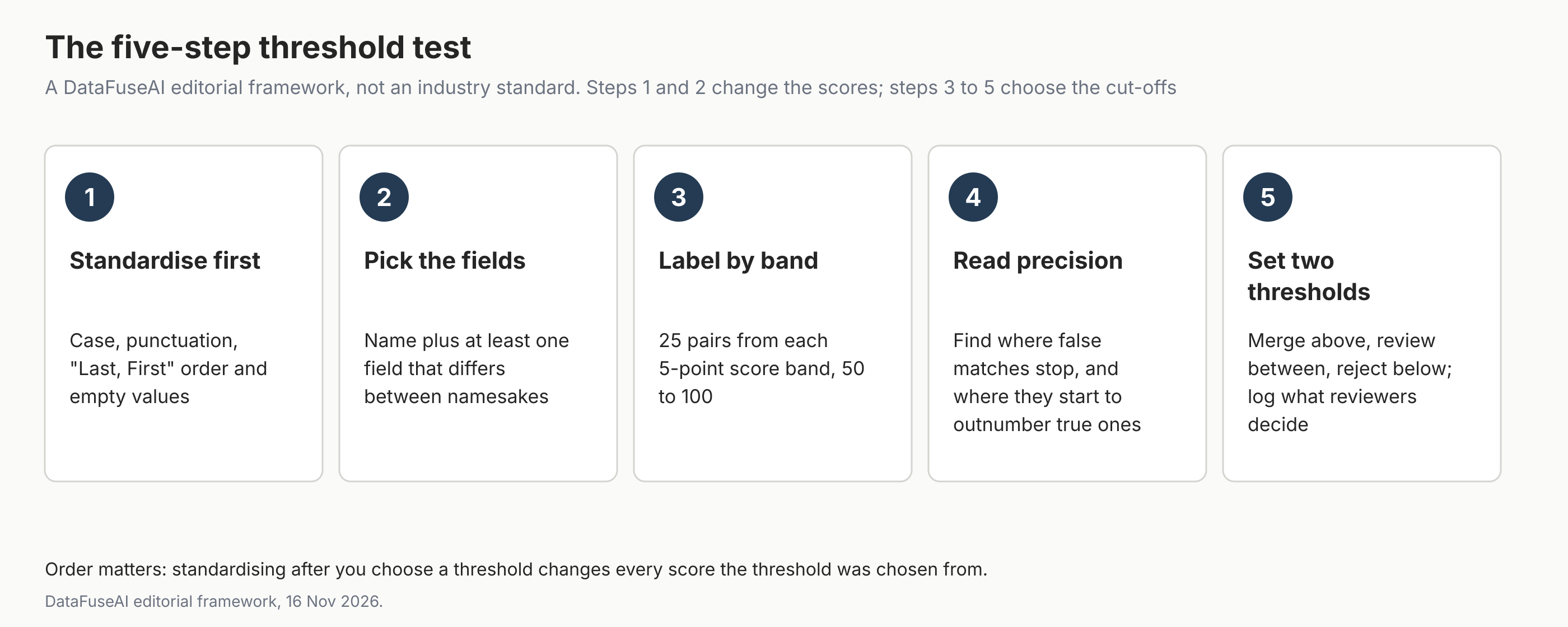
1. Standardise first. Lower-case names, strip punctuation, reorder "Last, First" and decide what an empty value is. In the sample above, standardising lifted "SMITH, ROBERT" from 7.7 to 100 without any threshold change.
2. Pick the fields. Score the name with at least one field that differs between namesakes, such as date of birth, phone or postcode. In our test, adding date of birth alone cut false matches at 85 from 444 to 20.
3. Label by band. Run the match with a low threshold, such as 50, and group pairs into five-point score bands. Label 25 pairs per band as same or different. Ten bands from 50 to 100 make 250 labels.
4. Read precision by band. Precision is the share of a band's pairs that are true matches. Find the band where false matches stop and the band where false matches start to outnumber true ones.
| Score band | Full name only: pairs | Full name only: precision | Seven-field mean: pairs | Seven-field mean: precision |
|---|---|---|---|---|
| 50 to 55 | 2,380 | 8.2% | 246 | 3.7% |
| 55 to 60 | 1,342 | 8.3% | 87 | 34.5% |
| 60 to 65 | 1,962 | 6.2% | 51 | 84.3% |
| 65 to 70 | 1,325 | 4.5% | 107 | 99.1% |
| 70 to 75 | 798 | 5.1% | 247 | 100% |
| 75 to 80 | 590 | 11.9% | 281 | 100% |
| 80 to 85 | 489 | 40.7% | 500 | 100% |
| 85 to 90 | 290 | 82.8% | 781 | 100% |
| 90 to 95 | 1,021 | 85.2% | 713 | 100% |
| 95 to 100 | 2,678 | 90.9% | 2,270 | 100% |
Precision measured on every pair in each band. Source: DataFuseAI threshold test on FEBRL 4, 16 November 2026.
Twenty-five labels per band locate the boundary, but they can miss a rare false match. The 65 to 70 band held one false match in 107 pairs, and a random 25 from it contains no false match 76.6% of the time. The 60 to 65 band held eight, and a 25-pair sample missed all of them only 0.25% of the time.
5. Set two thresholds. Put the upper threshold one band above the first band where your labels found no false match. Put the lower threshold at the top of the highest band where false matches outnumber true ones. Log every reviewer decision, so the next calibration starts from more labels.
Should you use one threshold or two?
One threshold has to serve both errors at once, so it always gives one of them away. Two thresholds split the pairs three ways: merge automatically above the upper one, send the middle band to a person, and reject below the lower one.
This design goes back to the foundations of record linkage. Fellegi and Sunter's 1969 model has three decisions, link, non-link and possible link, and warns that possible links need costly manual work [7]. Census practice holds pairs between the upper and lower cut-offs for clerical review [5].
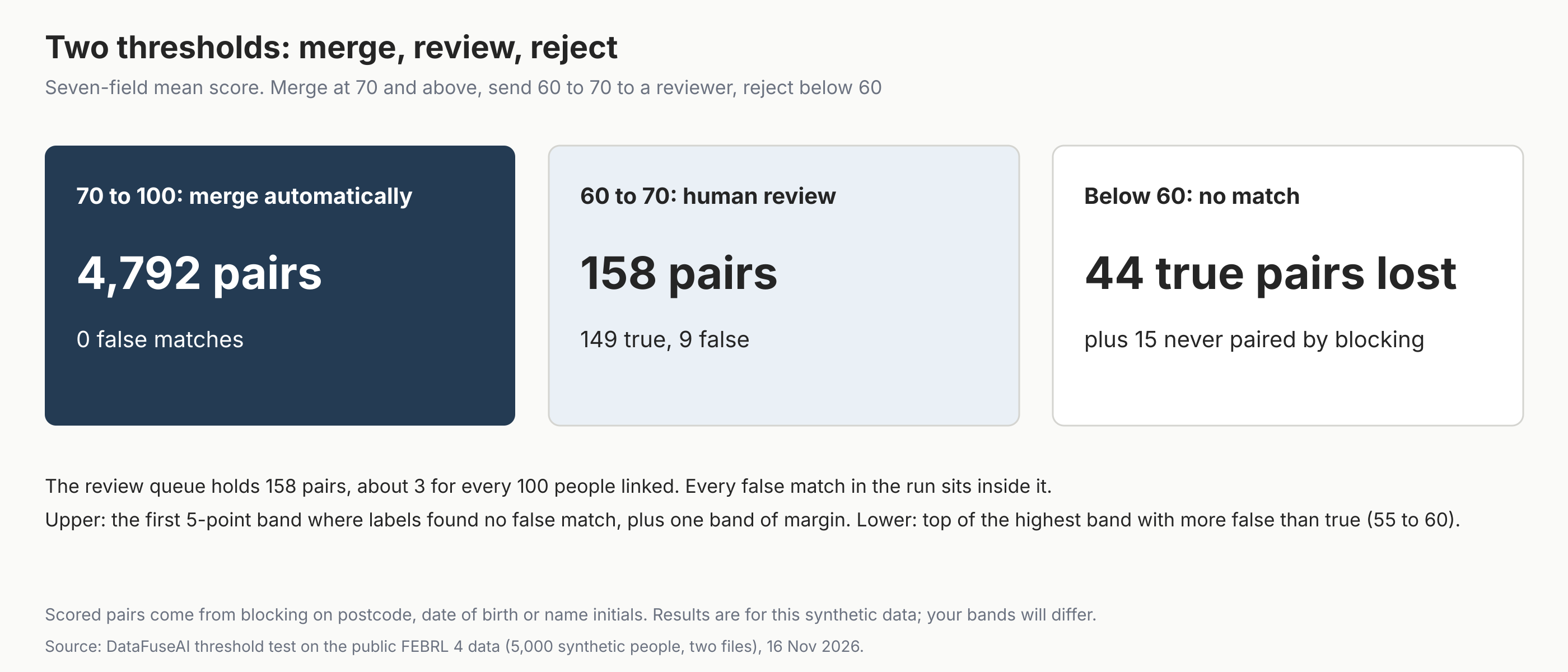
Applied to the seven-field mean, the usual sample result puts the upper threshold at 70. The lower threshold lands at 60, because the 55 to 60 band held 57 false matches against 30 true ones. When the 25 labels from the 65 to 70 band do catch its one false match, the rule gives 75 instead. The 4,792 merged pairs contained no false matches. The 158 pairs for review held 149 true and 9 false matches. Below 60, 44 true matches were lost, and blocking had already missed 15. The review queue was 0.3% of the 51,802 candidate pairs.
The width of the review band is a staffing decision. Raising the upper threshold to 75 adds 247 pairs to the queue and removes no false matches in this data. Size the band to what your reviewers can clear before the next run.
How published starting points compare
Published starting points for a fuzzy matching threshold run from 65 to 100, and they disagree because they describe different jobs: manual review, automatic merging or sanctions screening. None of the four pages below shows measured precision or recall behind its number, and they score with different methods. Treat each as a place to begin labelling, not a setting to ship.
| Source | Published starting point | Context given |
|---|---|---|
| DataFuseAI | 80 to 85 for general name matching; 90 to 95 where false merges carry compliance or patient-safety risk; 65 to 75 for exploratory audits | Validate against a labelled sample first [1] |
| Facctum | No number | Tune with historical alerts, scenario tests and alias tests [8] |
| Plauti | 80 to 85 for review jobs; 99 to 100 for automatic merging | Fix the empty-field rule first [6] |
| WinPure | 90 | Depends on your needs and goals [9] |
Source: each vendor's own page, checked 16 November 2026. Vendors after DataFuseAI, the publisher of this guide, are listed alphabetically.
Our data supports the shape of this advice more than any single number. On full names, 90 still produced 394 false matches. On seven fields, 70 produced none. Plauti's split between a review threshold and a higher merge threshold is the two-threshold design under another name.
Mistakes to avoid
- Tuning before standardising. "SMITH, ROBERT" scored 7.7 against "Robert Smith" until the name order was fixed.
- Raising the threshold to stop namesake merges. Identical names score 100, so only a second field can separate them.
- Using one threshold for short and long fields. One typo costs a four-letter name 25 points and a twenty-letter name 5.
- Labelling a random sample of all pairs. Most candidate pairs score low; sample by band so the boundary gets labels.
- Never re-labelling. A new source system changes the error mix, so rerun the band labels when one is added.
Where DataFuseAI fits (and where it doesn't)
DataFuseAI's Fuzzy Filter and Fuzzy Join score pairs with Levenshtein distance against a threshold you set [1]. Its data reconciliation page describes individual scoring, where one column passes its own threshold, and combined scoring, which weighs several columns into one score [10]. Each run records when it ran, how many rows matched and against which threshold [10].
Those match the two scoring styles in this test. The telecom walkthrough sets full_name against r_name at 85 in Individual Score mode, with a minimum you raise or lower [11]. The telecom industry page walks through that configuration step by step.
Combined scoring lets you set a weight and a threshold per column pair [10]. What the pages leave out matters as much. None of the DataFuseAI pages we read describes a labelling tool, a managed review queue or automatic threshold tuning. They also do not say how combined scoring treats an empty field, or how column weights are combined into one score. Steps 3 to 5 of the test therefore run outside the product, in a sheet or a review table you keep.
If you want to try the five steps on one recurring match, DataFuseAI's free 30-day POC asks for one recurring workflow and two or three data sources [12]. Applications are reviewed for fit, there is no POC fee or obligation, and external cloud costs stay with you [12].
Frequently Asked Questions
What is a good fuzzy matching threshold for names?
There is no single good number. In our test on 5,000 known matches, full-name scoring still created 243 false matches at a perfect 100, because different people shared names. Use 80 to 85 as a place to start labelling, then let the precision you measure in each score band set the final cut-offs.
How many pairs should I label to choose a threshold?
About 25 pairs per five-point score band is a practical start: ten bands from 50 to 100 make 250 labels. That is enough to locate where false matches stop, but it can miss a rare one. Keep one band of margin above the boundary, and add reviewer decisions to the labelled set after every run.
Can each field have its own threshold?
Yes. In an individual-score mode, each column pair is checked against its own threshold [1]. Short fields need lower settings, because one typo in a four-letter name already scores 75. In our test, requiring both name parts to pass 85 found 749 fewer true matches than scoring the full name, so label each field's bands separately.
Does a higher threshold always mean fewer false matches?
On a single score, false matches never rise as you raise it, but they can stop falling. Full-name scoring kept 243 false matches at both 95 and 100, because identical names cannot be separated. Changing what you score works differently: adding date of birth cut false matches at 85 from 444 to 20 and found more true matches.
Methodology
Data. FEBRL 4 from the Python Record Linkage Toolkit repository (commit b93d976, dated 20 July 2023): dataset4a.csv with 5,000 original records and dataset4b.csv with one duplicate of each [3]. The records are synthetic people generated by the Febrl data generator, so true matches are known by record ID [4]. The repository is BSD-licensed. The generator settings for this data set are not documented on the pages we read.
Candidate pairs. We kept pairs that share a postcode, an exact date of birth, or the first two letters of the surname plus the first letter of the given name. That gave 51,802 pairs, including 4,985 of the 5,000 true matches; the other 15 count as missed at every threshold.
Scoring. Each field was compared with DataFuseAI's published formula, (1 − Levenshtein distance ÷ longer length) × 100 [1], in plain Python. Multi-field scores are unweighted means; DataFuseAI's combined mode takes a weight per column, and weighted scores were not tested. A field empty on either side was left out of the mean unless stated.
Measures. A false match is a pair at or above the threshold whose records belong to different people. Counts are pairs, not merged clusters, and no one-to-one rule was applied. Band precision uses every pair in the band. The 25-label figures are exact sampling probabilities, computed in code. "People linked" means the 5,000 people in the test; the two files hold 10,000 records.
Robert Smith sample. The 28-record illustrative sample used across this series, scored with the same formula. It is not customer data.
Limits. Synthetic errors are independent across fields, while real household members share surnames, addresses and phones. Expect more multi-field false matches in real data than here. The test measures a scoring method, not DataFuseAI's product.
The scripts ran on 16 November 2026 between 16:46 and 16:55 UTC. The FEBRL files are public and the score formula is DataFuseAI's published one, so the counts can be reproduced.
References
- DataFuseAI. "Fuzzy Matching in ETL Pipelines: How It Works, Key Algorithms, and No-Code Implementation." 29 May 2026. Accessed 16 November 2026. https://www.datafuseai.com/blogs/fuzzy-matching-etl-pipelines
- Hand, D. and Christen, P. "A note on using the F-measure for evaluating record linkage algorithms." Statistics and Computing 28(3), 539-547. 1 May 2018. Accessed 16 November 2026. https://researchportalplus.anu.edu.au/en/publications/a-note-on-using-the-f-measure-for-evaluating-record-linkage-algor/
- Python Record Linkage Toolkit. "Datasets" (load_febrl4). Accessed 16 November 2026. https://recordlinkage.readthedocs.io/en/latest/ref-datasets.html
- Christen, P. "Data Set Generator Program generate.py." Febrl 0.3 manual, Australian National University. Accessed 16 November 2026. https://users.cecs.anu.edu.au/~Peter.Christen/Febrl/febrl-0.3/febrldoc-0.3/node70.html
- Winkler, W. E. "Advanced Methods for Record Linkage." U.S. Bureau of the Census research report RR94-05, 1994 (IRS Statistics of Income reprint). Accessed 16 November 2026. https://irs.gov/pub/irs-soi/1994preprintar27.pdf
- Plauti. "How to Reduce False Positives in Dedupe Matching (Without Losing Real Duplicates)." 23 April 2026. Accessed 16 November 2026. https://www.plauti.com/blog/how-to-reduce-false-positives-in-dedupe-matching-without-losing-real-duplicates
- Fellegi, I. P. and Sunter, A. B. "A Theory for Record Linkage." Journal of the American Statistical Association 64(328), 1183-1210. December 1969. Accessed 16 November 2026. https://cs.cornell.edu/~shmat/courses/cs6434/fellegi-sunter.pdf
- Facctum (Alex Rees). "How to Tune Fuzzy Matching Thresholds." 16 March 2026. Accessed 16 November 2026. https://www.facctum.com/blog/how-to-tune-fuzzy-matching-thresholds
- WinPure (Farah Kim). "Fuzzy Matching Common Mistakes." Undated. Accessed 16 November 2026. https://winpure.com/fuzzy-matching-common-mistakes/
- DataFuseAI. "Data Reconciliation: Fuzzy Matching Across Systems." Accessed 16 November 2026. https://www.datafuseai.com/solutions/data-reconciliation
- DataFuseAI. "Integrate and Reconcile Telecom Data Before It Reaches Your Billing Run." Accessed 16 November 2026. https://www.datafuseai.com/industries/telecommunication
- DataFuseAI. "Free 30-Day POC." Accessed 16 November 2026. https://www.datafuseai.com/free-poc
 Request a Demo