
The security review asks one question: where does our customer data go when the pipeline runs? The vendor's sales deck says "EU region". The vendor's own documentation says the control plane is in the United States and some fields pass through it.
A cloud-based data integration platform is a service, run by a vendor or a cloud provider, that connects to your systems, moves their data and transforms it. You don't manage the servers underneath [1]. This guide compares 12 of them on three things buyers check too late: where pipelines run, what each vendor's documentation says sits outside your chosen region, and what moving data between regions and clouds costs.
Who this is for: data, IT and security leads who have decided a vendor-run service is acceptable and now need to pick one. If you are still deciding between managed cloud, private-hosted and on-premise, start with our deployment decision framework.
Disclosure: DataFuseAI publishes this guide and is one of the 12 platforms in it. Platforms appear in alphabetical order. We don't rank them, and every vendor fact comes from that vendor's own pages. Vendor facts and prices checked 5 November 2026.
Key takeaways
- A region setting covers less than it seems. Several vendors document exceptions: Airbyte Cloud runs cursor and primary key data through its US control plane, and Fivetran stores email and event data in the US by default unless the destination runs in the EU or UK [2] [3].
- Control planes and runtimes can sit in different places. MuleSoft states that a runtime region is independent of control-plane data residency [4].
- Some region choices are permanent. Qlik says you cannot change a tenant's region after setup [8].
- Moving data costs money even inside one cloud. Azure charges per GB between regions and to the internet, and EU switching rules from 12 January 2027 cover leaving a provider, not daily multi-cloud pipelines [18] [21] [23].
DataFuseAI's data integration platform runs in the cloud, private-hosted or on-premise, and its free trial starts with connecting your first source, with no credit card [27].
What is a cloud-based data integration platform?
A cloud-based data integration platform runs its software on infrastructure the vendor or cloud provider operates, so your team configures pipelines in a browser and never patches the servers. NIST's definition of software as a service describes the same split: the consumer does not manage or control the underlying cloud infrastructure [1].
That split is the benefit and the risk. You give up control of where the platform's own components run, so you depend on what the vendor documents and contracts. Our guide to what a data integration platform is covers the layers every platform needs, whether it runs in the cloud or not.
Many of the 12 also offer an agent or runtime you install in your own network, for sources the internet can't reach; Azure Data Factory's self-hosted integration runtime and IBM's secure agent are two examples [5] [7]. That hybrid pattern, and what still goes to the vendor, is covered in our enterprise data integration platform comparison. This guide stays with the vendor-hosted service itself.
What are the benefits of a cloud-based data integration platform?
The benefits come from three of the five essential characteristics NIST lists for cloud services: you provision capacity yourself, it scales out and in with demand, and usage is metered [1]. For a data team, that means fewer servers to run and costs that follow use.
- No infrastructure to operate. In a SaaS service the consumer doesn't manage the network, servers, operating systems or storage [1].
- Capacity that follows the workload. Cloud capabilities "can be elastically provisioned and released", in NIST's words, so month-end spikes don't need standing hardware [1].
- Pay for measured use. Cloud systems meter resource use [1]. Our no-code platform comparison shows how vendors' usage meters differ.
- Regions close to your data. At least 10 of the 12 vendors document more than one hosting location, so you can run pipelines near your sources and meet residency rules [2] [3] [4] [5] [7] [8] [9] [12] [13] [15].
These benefits hold only if the platform can reach your sources. A database behind a firewall still needs a network link or an agent: Azure Data Factory, for example, needs ExpressRoute or a site-to-site VPN for on-premises stores in a managed virtual network [7].
What are the risks? The four-location check
The main risk of a cloud-based platform is assuming the region you pick covers everything. Vendor documentation shows four separate places to check: where pipelines run, where settings and run data live, what is carved out of your choice, and where copies go.
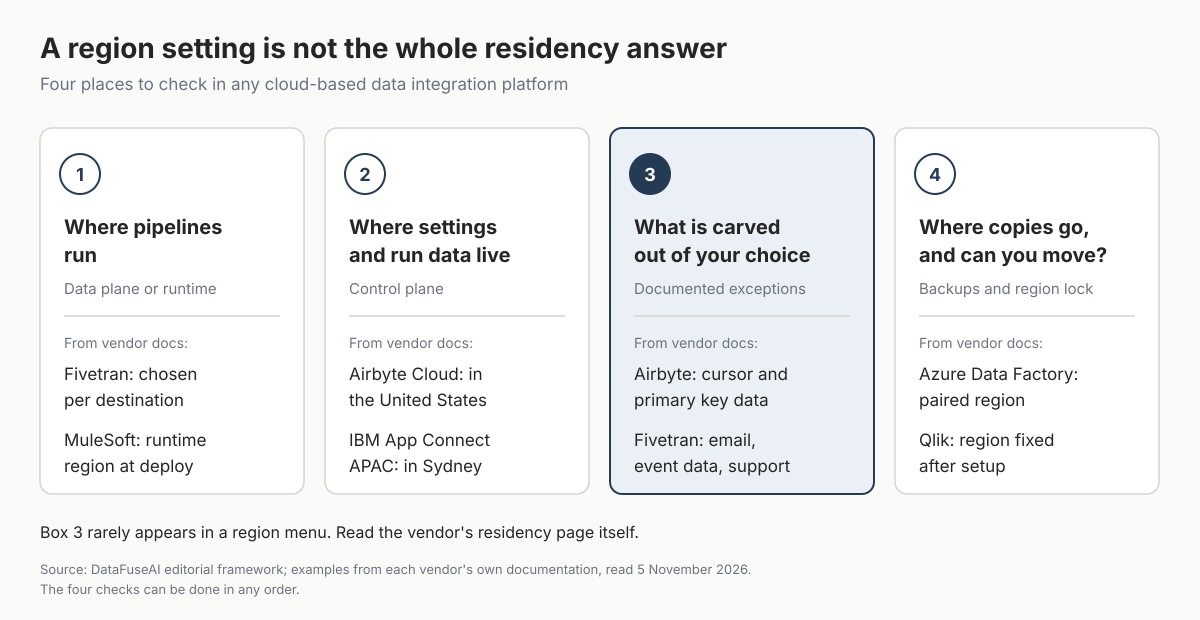
- Where pipelines run. This is the data plane or runtime region. Fivetran lets you pick the processing location per destination, on every plan [3]. In Azure Data Factory, the integration runtime's location defines where data movement and transformation happen [7].
- Where settings and run data live. This is the control plane. Airbyte Cloud's control plane is in the United States [2]. For IBM App Connect in Asia-Pacific, the control plane is hosted in Sydney while the data plane runs in the region you choose [5].
- What is carved out of your choice. Airbyte runs cursor and primary key data through its control plane and advises against using data that can't be processed in the US as a cursor or key [2]. Fivetran stores email and event data in the US by default unless the destination runs in the EU or UK, and sells US-only support access at extra cost [3].
- Where copies go, and whether you can move. Azure Data Factory supports Microsoft-managed, best-effort failover to the paired region, except in Brazil South and Southeast Asia, where its data is stored only in the local region [6]. Qlik lists a backup region for 9 of its 14 tenant regions, and the tenant region can't be changed after setup [8].
Two further risks sit outside residency. Features can differ by region: Boomi says some North American platform services aren't yet available on its UK platform [9]. And outages follow the provider. MuleSoft's CloudHub 2.0 runs on AWS, so its availability depends on Amazon services, although applications keep running during a network partition from the control plane [17].
The 12 cloud-based data integration platforms compared
Besides DataFuseAI, the platforms split into four groups: managed ELT services, a cloud provider's own service, application integration platforms (iPaaS) and broader data management suites. The table shows what each vendor's documentation says about hosting, what you choose and what sits outside that choice.
| Platform | Group | Where the vendor hosts it | What you choose | What the docs place outside your choice |
|---|---|---|---|---|
| Airbyte Cloud | Managed ELT | Managed regions US, US-Central and EU [2] | Workspace region; Enterprise Flex adds your own data-plane regions [2] | US control plane; cursor and primary key data; Connector Builder testing [2] |
| Azure Data Factory | Cloud provider service | Azure regions; a managed virtual network runtime shares the factory's region [7] | Integration runtime region, or auto-resolve by rules [7] | Microsoft-managed failover to the paired region, except Brazil South and Southeast Asia, where data stays in-region [6] |
| Boomi | iPaaS | Two separate platforms, North America and Europe; runtime clouds in the Americas, Europe and Asia-Pacific [9] [10] | Platform and runtime cloud; Europe and Asia-Pacific runtime clouds are provisioned on request [11] | Users, processes and components can't be shared across the two platforms [9] |
| DataFuseAI | Data integration and preparation | Managed: the page names no region or cloud provider [16] | Managed, private-hosted on your servers or cloud, or offline on-premise [16] | Not stated for managed; ask before relying on it |
| Fivetran | Managed ELT | Google Cloud by default; also AWS and Azure; 13, 15 and 15 regions listed [3] | Geography on all plans; provider on Enterprise and Business Critical; region on Business Critical [3] | Email and event data stored in the US by default unless the destination is in the EU or UK; US-only support costs extra [3] |
| IBM App Connect | iPaaS | AWS: N. Virginia, London, Frankfurt, Sydney and Mumbai [5] | Region per instance [5] | Asia-Pacific control plane hosted in Sydney [5] |
| Informatica IDMC | Data management suite | 17 PODs listed across US, Canada, Asia-Pacific, Europe and UK login hosts [12] | Not stated on the page we read; ask how a POD is assigned | Not stated on the page we read |
| Jitterbit Harmony | iPaaS | Three regions: NA, EMEA and APAC [13] | Region tied to the Harmony organisation [13] | A user's organisations must all be in one region [13] |
| Matillion | Managed ELT | Hosted SaaS or hybrid deployment [14] | Not verified (see Methodology) | Not verified (see Methodology) |
| MuleSoft Anypoint | iPaaS | Nine MuleSoft-managed control planes, including US, EU, Canada, Japan, India, Australia and UK [4] | Control plane for the organisation, then a runtime region at deploy [4] | Runtime region is independent of control-plane residency [4] |
| Qlik Talend Cloud | Data management suite | 14 tenant regions (AWS region codes), 9 with a listed backup region [8] | Region at tenant setup [8] | Region can't be changed after setup; contact support to move [8] |
| SnapLogic | iPaaS | Two control planes: Global (hosted in the US) and EMEA [15] | Control plane; moving from Global to EMEA is a planned migration [15] | Not stated on the page we read |
Source: each vendor's own documentation, read 5 November 2026, as cited. The Group column is a DataFuseAI editorial grouping. "Not stated" means the page we read doesn't say; it isn't a finding that the vendor lacks a control.
Which cloud-based data integration platform should you choose?
Start from your hardest constraint, not the feature list. If metadata must stay in the EU, the control plane matters more than the runtime. If you're on one cloud, its native service avoids a second vendor. If data can't leave your network, no vendor-hosted service fits.
| If your hardest constraint is... | Shortlist from this guide | Check this first |
|---|---|---|
| Pipeline data and settings must stay in the EU | MuleSoft EU Cloud; Qlik tenant regions in Frankfurt, Ireland, Paris or Stockholm [4] [8] | Boomi's European platform is its United Kingdom instance [9]; SnapLogic's EMEA page names no country [15]; Airbyte Cloud keeps cursor and key data in its US control plane [2] |
| A specific country: Japan, India, Australia or Canada | Fivetran geographies, MuleSoft country control planes, Qlik tenant regions [3] [4] [8] | IBM's Asia-Pacific control plane is in Sydney [5] |
| You run mainly on Azure | Azure Data Factory [7] | Pin the integration runtime region instead of auto-resolve [7] |
| You want a region choice without the top plan | Fivetran, where geography is on all plans [3] | A specific cloud region needs Business Critical [3] |
| Sources sit inside your network | Any platform with an agent or self-hosted runtime [5] [7] | Our enterprise comparison covers what leaves your network |
| Data can't leave your network at all | Not a vendor-hosted service; self-managed options include Airbyte Core, MuleSoft Private Cloud Edition and DataFuseAI on-premise [2] [4] [16] | The deployment framework linked at the top sets the order of questions |
Source: rows are DataFuseAI's editorial judgement; each shortlisted fact is cited to the vendor's own page, checked 5 November 2026.
What does moving data cost in a cloud-based platform?
The transfer bill depends on where data crosses a boundary: between regions, between clouds or out to the internet. Azure, for example, publishes free inbound transfer, $0.02 per GB between regions within North America or Europe, and $0.05 per GB to another continent [18]. Internet egress routed over Microsoft's network costs $0.087 per GB after the first 100 GB a month [18].
The integration platform decides some of that bill. In Azure Data Factory, the integration runtime's location defines where data moves, and auto-resolve picks a location by rules based on source and sink [7]. A runtime that lands in the wrong region adds a cross-region hop.
Illustrative example. A nightly pipeline copies 50 GB from an Azure database to a warehouse, 30 runs a month, so 1,500 GB. At Azure's published rates for a North America or Europe source [18]:
| Where the warehouse sits | Monthly transfer charge | Yearly |
|---|---|---|
| Same Azure region | No inter-region charge | No inter-region charge |
| Another Azure region on the same continent | $30.00 | $360.00 |
| An Azure region on another continent | $75.00 | $900.00 |
| Another cloud, over the internet | $121.80 (first 100 GB free) | $1,461.60 |
Illustrative. Source: Azure list rates read 5 November 2026; arithmetic run in code. Excludes the integration platform's own fees, compute and any charges at the destination. Contract rates can differ.
Leaving a provider is a different case. AWS waives data transfer out to the internet for eligible customers moving all their data off AWS, as credits after approval by AWS Support [19]. Google Cloud offers free network data transfer to customers migrating their data off Google Cloud [20]. Azure offers free egress for customers leaving Azure [18].
The EU Data Act makes that permanent for switching. From 12 January 2027, providers of data processing services to customers in the EU may not impose switching charges, and the Act's definition of switching charges includes data egress charges [21] [22]. Until then, reduced charges must not exceed the provider's costs directly linked to the switch [21].
Daily multi-cloud pipelines aren't switching. Where one service is used in parallel with another, providers may still charge egress to pass on their costs, without exceeding them [23]. We aren't lawyers: whether a contract falls in scope is a question for your counsel. Our vendor lock-in guide covers the other exit costs.
How to test residency and egress before you sign
Test residency the way you test connectors: with written answers and one real run. Six checks, each with a pass condition, cover the four locations and the egress bill. Ask for answers in the contract or the vendor's public documentation, not in a sales email.
| Check | How | Pass when |
|---|---|---|
| Runtime region | Run one real pipeline and read the region in the run details or the cloud bill | It matches the region you chose |
| Control plane location | Ask where configuration, credentials, logs and run history are stored | The vendor names a location in writing |
| Carve-outs | Ask for the list of data processed or stored outside your region, such as cursors, event data and support access | The list matches the vendor's documentation [2] [3] |
| Backups and failover | Ask where backups and failover copies go | Named regions, as Azure and Qlik document [6] [8] |
| Region move | Ask how to move to another region later | A documented procedure, as Fivetran's new-destination route [24], or a stated limit, as Qlik's [8] |
| Egress estimate | Price your monthly volume at the cloud provider's published rates | The estimate covers every hop: source, runtime and destination [18] |
Source: DataFuseAI editorial checklist; the examples in the pass column are from the vendor pages cited.
Mistakes to avoid
- Treating the region menu as the residency answer. Read the vendor's residency page; carve-outs live there, not in the menu [2] [3].
- Ignoring the control plane. A runtime region doesn't move it: MuleSoft's US Cloud control plane has United States data residency wherever the runtime runs [4].
- Leaving runtime placement on automatic. Auto-resolve picks a location by rules; pin it when region matters [7].
- Choosing a region you can't leave. Qlik's tenant region is fixed after setup, so decide before the first pipeline [8].
- Reading the 2027 Data Act rule as free multi-cloud. It ends switching charges; in-parallel egress at cost is still allowed [21] [23].
Where DataFuseAI fits (and where it doesn't)
DataFuseAI, the publisher of this guide, offers three deployment models: managed, private-hosted on your own servers or cloud, and on-premise with no external hosting and no internet dependency [16]. For residency-sensitive work, the private-hosted and on-premise models keep the platform inside infrastructure you control.
Fits:
- Teams that want to choose, from one vendor, between a vendor-run service, their own servers or cloud account, and an offline install [16].
- Pipelines from databases, cloud database services, files, FTP and SFTP, S3 and REST APIs [25] [27].
- Regulated or restricted networks where an offline on-premise deployment is required [16].
May not fit:
- Buyers who need a published region list for the managed service: the deployment page names no region or cloud provider, so ask before you rely on it [16].
- Pipelines from SaaS applications such as a CRM: the connectors page lists no pre-built SaaS app connectors, only a generic REST API connector [25].
- Streaming sources: DataFuseAI does not support Kafka, Kinesis or Pub/Sub [26].
- Teams that need list prices up front: the DataFuseAI pages cited here list no prices [16] [27].
The 30-day proof of concept covers 2 to 3 sources and one workflow. Applications are reviewed and not every applicant is accepted; there is no POC fee, and external infrastructure costs stay with you [28].
Frequently Asked Questions
Is a cloud-based data integration platform the same as iPaaS?
Not always. Estuary's category table separates iPaaS and app integration, for connecting business apps and automating workflows, from SaaS ELT connectors, for loading app data into cloud warehouses [29]. Both run in the cloud. In this guide, Boomi, IBM App Connect, Jitterbit, MuleSoft and SnapLogic sit in the iPaaS group, and Airbyte, Fivetran and Matillion in managed ELT.
Does choosing an EU region make a platform GDPR-compliant?
No setting does that by itself. Region choice is one input to your data protection review, alongside the vendor's subprocessors, support-access terms and transfer safeguards. Fivetran shows why access is separate from location: it sells US-only support access as an extra option [3]. Ask your data protection officer which of the four locations matter for your data.
Can we move a cloud data integration platform to another region later?
It depends on the vendor. Fivetran lets you change a destination's processing location, and a second region needs a new destination connection [24]. Qlik's tenant region can't be changed after setup [8]. SnapLogic documents moving from its Global to its EMEA control plane as a planned migration [15]. Jitterbit ties the region to the organisation [13].
Do cloud platforms work with on-premises databases?
Usually through an agent or a network link. Azure Data Factory offers a self-hosted integration runtime, or a managed virtual network connected over ExpressRoute or a site-to-site VPN [7]. IBM App Connect uses a secure agent for applications in an enterprise network [5]. Our enterprise comparison covers what such agents still send to the vendor.
Why aren't AWS Glue or Zapier on this list?
AWS Glue was listed in only one of the five roundups we used, so it fell below our selection rule. Zapier was listed in two, but its documentation describes it as connecting apps into automated workflows triggered by app events [30]. That is workflow automation rather than moving data sets for analysis, so we left it out.
Methodology
How the 12 were chosen. We read five roundups of cloud data integration platforms published or updated from 2024 onwards. They come from Airbyte (updated 8 September 2026) [31], Analytics Insight (15 September 2024) [32], DCKAP (6 January 2026) [33], FitGap (February 2026) [34] and Estuary (updated 14 May 2026) [29]. Airbyte, DCKAP and Estuary are vendors that list themselves. Together they list 52 entries; Estuary names Airbyte twice, which we counted once, leaving 51 entries covering 33 products. We mapped older names to current products: Informatica IICS to IDMC, and Talend Cloud, Talend (Qlik) and Talend Data Fabric to Qlik Talend Cloud. Airbyte qualifies through its own roundup plus Estuary's. We included every product listed in at least two, which gave 12, then excluded Zapier as workflow automation and added DataFuseAI as publisher. Products listed once were left out, including AWS Glue, Google Cloud Data Fusion, Hevo Data, Skyvia, Stitch and Workato. A 2022 roundup from Itransition was excluded by the date rule.
What we read. For each platform, we read the vendor's own documentation on hosting regions and data residency on 5 November 2026, between about 16:25 and 16:40 UTC. Azure bandwidth prices, the AWS and Google Cloud exit announcements and the Data Act articles were read in the same window. The Data Act text was read through Springlex's reproduction of the Official Journal; the official text is on EUR-Lex [21].
Limits. These are published documentation, not contracts or tests: we didn't run pipelines on any platform. Matillion's region documentation now redirects to a domain our environment couldn't open, so its cells say "Not verified". Microsoft's data redundancy page was read in English under a Norwegian locale URL. SnapLogic's documentation is served from a content-delivery domain. Informatica's page doesn't say how a POD is assigned. The Group column and the decision table are editorial. Azure prices are list prices and change.
References
- NIST, "The NIST Definition of Cloud Computing", Special Publication 800-145, September 2011. https://nvlpubs.nist.gov/nistpubs/Legacy/SP/nistspecialpublication800-145.pdf
- Airbyte, "Manage data residency" (Airbyte Cloud documentation), read 5 Nov 2026. https://docs.airbyte.com/platform/cloud/managing-airbyte-cloud/manage-data-residency
- Fivetran, "Privacy: Fivetran data residency" (documentation), read 5 Nov 2026. https://fivetran.com/docs/privacy
- MuleSoft, "Anypoint Platform Hosting Overview" (documentation), read 5 Nov 2026. https://docs.mulesoft.com/hosting-home/
- IBM, "App Connect Enterprise as a Service: solution architecture" (documentation), read 5 Nov 2026. https://www.ibm.com/docs/en/app-connect/saas?topic=overview-solution-architecture
- Microsoft Learn, "Azure Data Factory data redundancy" (English text, Norwegian locale URL), read 5 Nov 2026. https://learn.microsoft.com/nb-no/azure/data-factory/concepts-data-redundancy
- Microsoft Learn, "Choose the right integration runtime configuration for your scenario", last updated 25 Sep 2024, read 5 Nov 2026. https://learn.microsoft.com/en-au/azure/data-factory/choose-the-right-integration-runtime-configuration
- Qlik, "Creating and configuring your tenant" (Qlik Cloud Help), last updated 5 Nov 2026. https://help.qlik.com/en-US/cloud-services/Subsystems/Hub/Content/Sense_Hub/Introduction/qcs-tenant-domain.htm
- Boomi, "Boomi Enterprise Platform regions and destinations" (documentation), read 5 Nov 2026. https://help.boomi.com/bundle/atomsphere_platform/page/c-boo-Hostnames_and_IP_Addresses_for_Connecting.html
- Boomi, "The Boomi runtime clouds" (documentation), read 5 Nov 2026. https://help.boomi.com/docs/Atomsphere/Integration/Getting%20started/c-atm-The_Boomi_Atom_Clouds_6c3bfab5-2fdc-4fde-a7cb-5f0c591a9f08
- Boomi, "Public clouds" (documentation), read 5 Nov 2026. https://help.boomi.com/docs/Atomsphere/Integration/Integration%20management/int-public_clouds
- Informatica, "Login" (Platform REST API version 3, POD name table), read 5 Nov 2026. https://docs.informatica.com/integration-cloud/cloud-platform/current-version/rest-api-reference/platform-rest-api-version-3-resources/login.html
- Jitterbit, "Find my Jitterbit Harmony region" (documentation), read 5 Nov 2026. https://docs.jitterbit.com/getting-started/support/my-region/
- Matillion, "Security" (product page), read 5 Nov 2026. https://www.matillion.com/security
- SnapLogic Documentation, "Migrate assets to the EMEA control plane", read 5 Nov 2026. https://d14w8g1erguuat.cloudfront.net/main/manager/migrate-emea.html
- DataFuseAI, "Deployment options", read 5 Nov 2026. https://www.datafuseai.com/platform/deployment-options
- MuleSoft, "CloudHub 2.0 High Availability and Disaster Recovery" (documentation), read 5 Nov 2026. https://docs.mulesoft.com/cloudhub-2/ch2-ha-dr
- Microsoft Azure, "Bandwidth pricing" (list prices), read 5 Nov 2026. https://azure.microsoft.com/en-us/pricing/details/bandwidth/
- AWS News Blog, "Free data transfer out to internet when moving out of AWS", 5 Mar 2024, updated 8 Oct 2026. https://aws.amazon.com/blogs/aws/free-data-transfer-out-to-internet-when-moving-out-of-aws/
- Google Cloud Blog, "Cloud switching just got easier: Removing data transfer fees when moving off Google Cloud", 11 Jan 2024. https://cloud.google.com/blog/products/networking/eliminating-data-transfer-fees-when-migrating-off-google-cloud
- Regulation (EU) 2023/2854 (Data Act), Article 29, read via Springlex's reproduction of the Official Journal. https://www.springlex.eu/en/packages/data-act/data-act-regulation/article-29/ Official text: https://eur-lex.europa.eu/eli/reg/2023/2854/oj
- Regulation (EU) 2023/2854 (Data Act), Article 2, points 35 and 36, read via Springlex. https://www.springlex.eu/en/packages/data-act/data-act-regulation/article-2/
- Regulation (EU) 2023/2854 (Data Act), Article 34(2), read via Springlex. https://www.springlex.eu/en/packages/data-act/data-act-regulation/article-34/
- Fivetran, "Can I Use Fivetran in More Than One Region?" (documentation), read 5 Nov 2026. https://fivetran.com/docs/using-fivetran/fivetran-dashboard/account-settings/troubleshooting/use-fivetran-multiple-regions
- DataFuseAI, "Data connectors", read 5 Nov 2026. https://www.datafuseai.com/platform/data-connectors
- DataFuseAI, "Batch vs CDC vs Streaming", 24 Aug 2026. https://www.datafuseai.com/blogs/batch-vs-cdc-vs-streaming
- DataFuseAI, "Data integration platform" (solution page), read 5 Nov 2026. https://www.datafuseai.com/solutions/data-integration-platform
- DataFuseAI, "Free POC", read 5 Nov 2026. https://www.datafuseai.com/free-poc
- Estuary, "Cloud Data Integration: Methods, Use Cases, Challenges, and Tools" (vendor-authored), updated 14 May 2026. https://estuary.dev/blog/cloud-data-integration/
- Zapier, "Glossary" (developer documentation), read 5 Nov 2026. https://docs.zapier.com/platform/quickstart/glossary
- Airbyte, "What Is Cloud Data Integration?: Top Tools & Best Practices in 2026" (vendor-authored), updated 8 Sep 2026. https://airbyte.com/data-engineering-resources/cloud-data-integration
- Analytics Insight, "Top Platforms for Cloud-Based Data Integration", 15 Sep 2024. https://www.analyticsinsight.net/amp/story/tech-news/top-platforms-for-cloud-based-data-integration
- DCKAP, "The Best Cloud Integration Tools in 2026" (vendor-authored), 6 Jan 2026. https://www.dckap.com/?p=29373
- FitGap, "Best cloud-based data integration tools of February 2026", page 1 (software directory). https://us.fitgap.com/search/data-integration-tools/cloud-based?page=1
 Request a Demo