
The pilot works and the pipelines run. Then legal reads the licence and finds that the "open source" tool may not be offered as a managed service, or becomes open source only in four years.
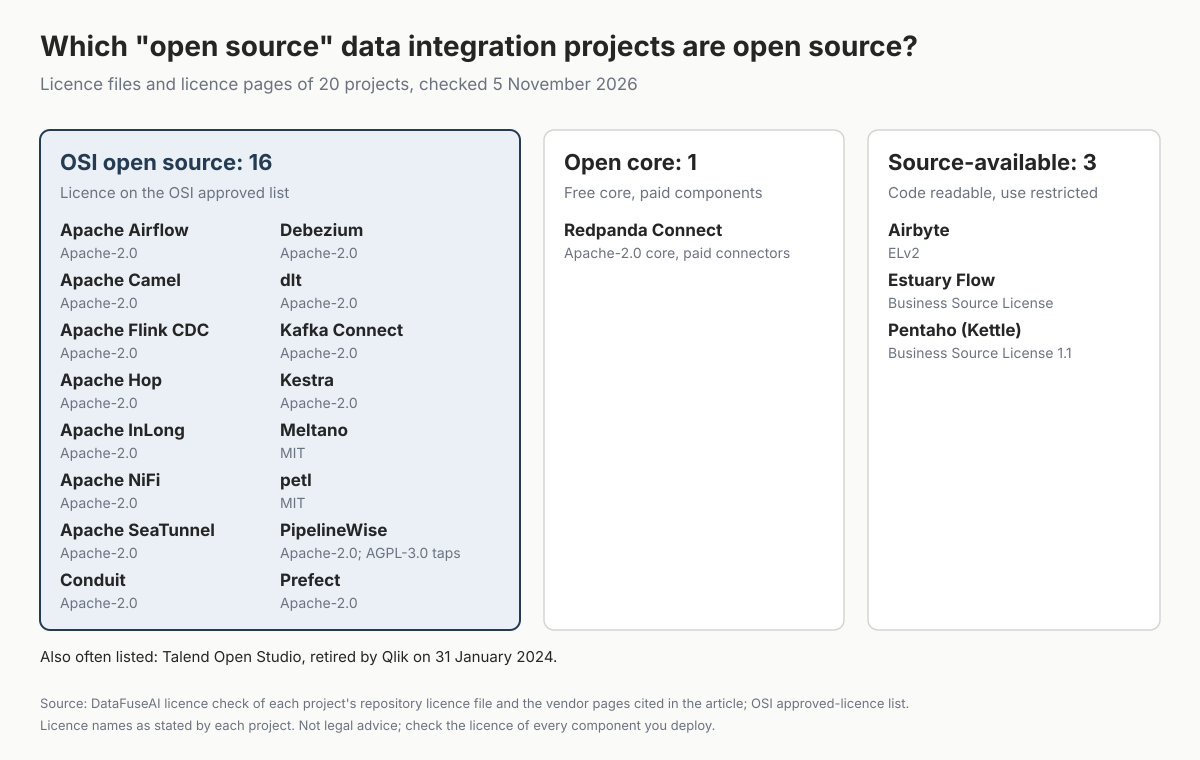
An open source data integration platform is software that moves and prepares data between systems under a licence the Open Source Initiative approves [1]. We read the licence files of 20 data integration projects on 5 November 2026: 16 are wholly under an OSI-approved licence and 4 are not. The 16 are Apache Airflow, Apache Camel, Apache Flink CDC, Apache Hop, Apache InLong, Apache NiFi, Apache SeaTunnel, Conduit, Debezium, dlt, Kafka Connect, Kestra, Meltano, petl, PipelineWise and Prefect. This guide covers what each is built for, the licence traps, and when a commercial platform makes more sense.
Who this is for: data engineers, platform teams and heads of data shortlisting a self-hosted tool. New to the category? Start with our guide to what a data integration platform is.
Disclosure: DataFuseAI publishes this guide and sells a commercial data integration platform that is not open source, so it isn't on the list. Projects appear in alphabetical order. We don't rank them.
Key takeaways
- "Open source" is a licence question first. Apache 2.0 and MIT are on the OSI approved list; the Elastic License 2.0 and the Business Source License are not [1].
- The 16 do different jobs: visual pipelines, change data capture, streaming pipelines, Kafka connectors, Python loading, declarative ELT, bulk sync, application integration and orchestration. Pick by job, not by popularity.
- The licence is free; the operations aren't. Hosting, upgrades, access control, audit evidence and connector fixes stay with your team.
- Go commercial when nobody will own those operations, or when auditors need controls the open-source edition doesn't document.
Figures checked 5 November 2026.
What counts as an open source data integration platform?
An open source data integration platform is one whose licence complies with the Open Source Definition, which the OSI summarises as letting software be freely used, modified and shared [1]. The OSI list includes Apache 2.0 and MIT. It doesn't include the Elastic License 2.0 (ELv2) or the Business Source License (BSL) [1].
Three labels cover what you will meet in practice:
- Open source. The whole project is under an OSI-approved licence. Apache 2.0, for example, grants a "no-charge, royalty-free" licence to reproduce, modify and distribute the work [17].
- Open core. A free core plus components that need a paid licence. Redpanda Connect is an example: its licence notes put most connectors under Apache 2.0 and enterprise features under the Redpanda Community License (RCL), and its Enterprise connectors need a paid plan [15].
- Source-available. You can read and often modify the code, but the licence restricts some uses. Airbyte's ELv2 licence, for instance, forbids providing the software to third parties "as a hosted or managed service, where the service provides users with access to any substantial set of the features or functionality of the software" [12].
For this guide, a data integration platform is any project whose main job is moving data between systems, or orchestrating that movement. That includes libraries such as dlt, runtimes such as Kafka Connect and orchestrators such as Airflow, Kestra and Prefect, not only tools with a visual designer.
The 16 open source data integration platforms compared
The table compares the 16 projects on licence, the job each was built for, how you define pipelines, and the movement patterns each documents. Every cell comes from the project's own README, homepage or documentation. Our licence check covers the licence column.
| Project | Licence | Built first to | How you build pipelines | Movement it documents |
|---|---|---|---|---|
| Apache Airflow [24] | Apache 2.0 | Author, schedule and monitor workflows | Python code (DAGs) with built-in operators | Orchestration; its README says tasks shouldn't pass large quantities of data between them |
| Apache Camel [5] | Apache 2.0 | Connect applications, APIs and message brokers using Enterprise Integration Patterns; 350+ connectors | Routes in Java, YAML or XML, run on Spring Boot, Quarkus or the Camel CLI | Message and event routing between systems |
| Apache Flink CDC [28] | Apache 2.0 | Real-time and batch data integration built on Apache Flink | YAML pipelines, SQL or the DataStream API | CDC, full-database and sharded-table sync, schema evolution |
| Apache Hop [3] | Apache 2.0 | Design data pipelines and workflows visually | Visual canvas; run locally, on Hop Server, natively on Spark, or on Flink and Dataflow through Apache Beam | Pipelines on the runtime you choose |
| Apache InLong [25] | Apache 2.0 | Ingest, synchronise and subscribe to very large data streams | SDK, command-line tool or dashboard | Batch and stream, between databases, queues and data lakes |
| Apache NiFi [2] | Apache 2.0 | Process and distribute data, with provenance tracking | Browser UI; Python processors; REST API | Flows with guaranteed delivery, retries and clustering |
| Apache SeaTunnel [4] | Apache 2.0 | Synchronise large volumes of data; 160+ connectors | Job configuration on the Zeta, Flink or Spark engine | Batch, real-time, CDC and full-database sync |
| Conduit [26] | Apache 2.0 | Build and run real-time data pipelines; written in Go | Pipeline configuration files or the HTTP API; connectors as plugins | Streaming records, with order kept and acknowledgements |
| Debezium [7] | Apache 2.0 | Change data capture from databases | Connectors on Kafka Connect, or an embedded engine in your application | Row-level change events |
| dlt [9] | Apache 2.0 | Load data from APIs and Python sources | Python library; runs in a notebook, a function, an Airflow DAG or a laptop | Loads with schema inference and typing |
| Kafka Connect (Apache Kafka) [6] | Apache 2.0 | Run source and sink connectors for Kafka | Connector configs via properties files or a REST API; standalone or distributed | Data into and out of Kafka topics |
| Kestra [11] | Apache 2.0 | Orchestrate scheduled and event-driven workflows; hundreds of plugins | YAML, a no-code editor or AI Copilot, all editing the same flow | Scheduled and event-driven runs |
| Meltano [8] | MIT | Declarative, code-first ELT with Singer taps and targets | Declarative project; plugins from Meltano Hub | Extract and load between taps and targets |
| petl [29] | MIT | Extract, transform and load tables of data in Python | Python package used in your scripts | Table-level ETL |
| PipelineWise [10] | Apache 2.0 core; available taps AGPL 3.0 | Replicate databases into PostgreSQL or Snowflake with Singer | Generated configuration and CLI; Docker recommended | Log-based, incremental and full-table replication |
| Prefect [30] | Apache 2.0 | Orchestrate data pipelines built in Python | Python flows, tracked on a self-hosted server or Prefect Cloud | Scheduling, retries, caching and event-based runs |
Source: each project's README, homepage or documentation [2] to [11], [24] to [26], [28] to [30]; licences from each repository's licence files, read 5 November 2026. Alphabetical; not a ranking.
Fifteen of the 16 had a commit on their default branch within a day of our check. Apache InLong's latest was 49 days earlier, inside our 90-day criterion. The Methodology section explains the criteria.
Which open source data integration platform should you choose?
Choose an open source data integration platform by the job you need done first. A visual ETL designer, a change data capture engine and a Python loading library are all "data integration", but swapping one for another rarely works.
| If you need | Start with | Why, from the project's own documentation |
|---|---|---|
| Python-defined workflows across many systems | Apache Airflow | Authors, schedules and monitors workflows as code [24] |
| Visual pipelines a mixed team can read and change | Apache Hop or Apache NiFi | Hop designs pipelines on a canvas [3]; NiFi has a browser UI for design, control and monitoring [2] |
| CDC with full-database sync on Flink | Apache Flink CDC | Built on Flink, with full-database sync and schema evolution [28] |
| Change data capture from operational databases | Debezium | Built for CDC, with connectors for MariaDB, MongoDB, MySQL, Oracle, PostgreSQL and SQL Server in its main repository [7] |
| Data moving into and out of Kafka | Kafka Connect | Ships with Apache Kafka and runs source and sink connectors [6] |
| High-volume sync, batch and real time, across many systems | Apache SeaTunnel | Lists 160+ connectors; its CDC sources run on the Zeta and Flink engines [4] [27] |
| Very large streams with publish-and-subscribe | Apache InLong | Built at Tencent for ingestion, synchronisation and subscription of massive data [25] |
| Real-time pipelines from one Go binary | Conduit | Ships Kafka, PostgreSQL, S3 and file connectors and keeps record order [26] |
| Loading APIs into a warehouse from Python code | dlt | A Python library that handles requests, pagination and schema inference [9] |
| Declarative ELT with existing Singer connectors | Meltano | Finds plugins and Singer taps and targets through Meltano Hub [8] |
| Table ETL inside Python scripts | petl | A Python package for extracting, transforming and loading tables [29] |
| MariaDB or PostgreSQL replicated into PostgreSQL or Snowflake | PipelineWise | Those are its available routes; others are experimental [10] |
| Integration inside an application: APIs, queues, files | Apache Camel | A framework you add to a Spring Boot or Quarkus project [5] |
| Event-driven workflows defined in YAML | Kestra | Orchestrates scheduled and event-driven workflows with plugins [11] |
| Turning Python scripts into scheduled workflows | Prefect | Adds scheduling, retries and event-based automation to Python code [30] |
Source: DataFuseAI editorial guidance, based on each project's documentation as cited.
Many teams combine two: Debezium for capture with Kafka Connect underneath, or dlt jobs scheduled by Airflow or Kestra. Our comparison of batch, CDC and streaming helps decide how fresh the data needs to be before you pick a capture tool.
The 16 platforms in brief
Apache Airflow
Apache Airflow is a platform to programmatically author, schedule and monitor workflows, licensed Apache 2.0 [24]. Pipelines are Python code, and built-in operators connect to many systems [24]. It suits teams that want one scheduler for data, machine learning and other jobs. Watch for: its README says tasks should be idempotent and shouldn't pass large quantities of data between them, so plan where the data itself moves [24].
Apache Camel
Apache Camel is an integration framework with 350+ connectors for databases, APIs, message brokers and cloud services [5]. You write routes in Java, YAML or XML and run them on Spring Boot, Quarkus or the Camel CLI [5]. It suits developers building integration into an application. Watch for: Camel is code you deploy and operate, so scheduling, monitoring and access control come from the application around it.
Apache Flink CDC
Flink CDC is a distributed data integration tool for real-time and batch data, built on Apache Flink and licensed Apache 2.0 [28]. Its README lists full-database and sharded-table synchronisation, schema evolution and transformation [28]. Pipelines can be defined in YAML with no code, or through its SQL and DataStream APIs [28]. Watch for: it runs on Flink, so plan for Flink operations as well.
Apache Hop
Apache Hop is a visual platform for data integration and orchestration. The same pipeline can run locally, on Hop Server, natively on Spark or Databricks, or on Flink and Dataflow through Apache Beam [3]. Projects and environments keep configuration and credentials out of the pipelines [3]. Watch for: Hop needs a Java 21 environment, and Beam runs need a "fat jar" built from your installation [3].
Apache InLong
Apache InLong describes itself as a one-stop, full-scenario integration framework for massive data, covering ingestion, synchronisation and subscription [25]. It was built at Tencent and supports batch and stream processing [25]. Its README lists extract nodes such as Kafka, MySQL, Oracle and PostgreSQL, and load nodes such as ClickHouse, Doris, Hive and Iceberg [25]. Watch for: it runs as five modules (ingestion, convergence, caching, sorting and management), so plan for a team to operate them [25].
Apache NiFi
Apache NiFi processes and distributes data through flows you design in a browser [2]. Its README lists guaranteed delivery with retry and backoff, clustering, provenance tracking with graph lineage, single sign-on through OpenID Connect or SAML 2, and role-based authorization policies [2]. It suits routing and moving data between many systems. Watch for: it is built to move and route data, so plan analytics modelling elsewhere, such as in the warehouse.
Apache SeaTunnel
Apache SeaTunnel describes itself as a "multimodal, high-performance, distributed data integration tool" [4]. Its README lists over 160 connectors, real-time, CDC and full-database synchronisation, and the choice of its Zeta engine, Flink or Spark [4]. It suits large, many-table sync jobs. Watch for: you pick and operate an engine, and jobs are defined in configuration rather than on a canvas.
Conduit
Conduit is a data streaming tool written in Go for building and running real-time data pipelines [26]. It ships built-in connectors for Kafka, PostgreSQL, S3 and files, runs other connectors as plugins over gRPC, and can wrap Kafka Connect connectors [26]. It keeps records in order and acknowledges a record only after every destination has processed it [26]. Watch for: the README says its API is unauthenticated by default, so keep it on localhost or set an API token; the container image won't start without one [26].
Debezium
Debezium is a change data capture platform that emits an event for each row-level change committed in a database [7]. It normally runs as connectors on Kafka Connect; applications that don't need that can use its embedded engine instead [7]. The main repository holds connectors for MariaDB, MongoDB, MySQL, Oracle, PostgreSQL and SQL Server, plus a JDBC sink [7]. Watch for: the standard deployment brings Kafka with it. Our explainer on change data capture covers when CDC is worth that.
dlt
dlt (data load tool) is a Python library for loading data. You describe an API or pass any Python iterable, and dlt handles requests, pagination, schema inference and typing [9]. It runs wherever Python runs, including notebooks, cloud functions and Airflow DAGs [9]. Watch for: it is a library, so hosting and scheduling are yours. Its maintainers launched dltHub, a managed platform, in March 2026 [9].
Kafka Connect (Apache Kafka)
Kafka Connect is the connector runtime that ships with Apache Kafka. It runs in standalone mode, a single process, or distributed mode, which balances work and tolerates failures [6]. Connectors load from a plugin path [6], and Kafka's own repository includes file connectors and MirrorMaker [6]. Database connectors such as Debezium are separate projects [7]. Watch for: each connector has its own maintainer and licence, so check both.
Kestra
Kestra is an event-driven orchestration platform for data, AI and infrastructure workflows, licensed Apache 2.0 [11]. Flows are YAML, and a no-code editor and AI Copilot edit the same flow [11]. Its plugins extract data from databases, cloud storage and APIs [11]. Watch for: the README lists action-based RBAC, policies and promotion between instances under Enterprise Edition [11].
Meltano
Meltano calls itself "the declarative code-first data integration engine", and it is MIT-licensed [8]. It uses Singer taps and targets, found through Meltano Hub, where users can also add plugins [8]. It suits teams that want ELT defined in version-controlled configuration. Watch for: because users can add plugins to the Hub, check who maintains each tap you depend on.
petl
petl is a general-purpose Python package for extracting, transforming and loading tables of data, released under the MIT licence [29]. It suits analysts and engineers who want table-level ETL in plain Python scripts. Watch for: it is a library, so scheduling, monitoring and access control come from whatever runs your scripts.
PipelineWise
PipelineWise is a framework for running Singer ELT pipelines, with log-based, incremental and full-table replication [10]. Its README now lists MariaDB and PostgreSQL as available sources and PostgreSQL and Snowflake as available targets; other packaged connectors are experimental [10]. It suits database replication on exactly those routes. Watch for: the core is Apache 2.0, but its licences page lists the MariaDB and PostgreSQL taps under AGPL 3.0, an OSI-approved licence with its own obligations [10]. The README also calls v0.64.1 the last release before the connector set was reduced, and doesn't recommend deploying it [10].
Prefect
Prefect is a workflow orchestration framework for building data pipelines in Python, licensed Apache 2.0 [30]. It adds scheduling, caching, retries and event-based automations to Python code, and tracks runs on a self-hosted Prefect server or the managed Prefect Cloud [30]. It suits Python teams turning scripts into production workflows. Watch for: it orchestrates the work, so check which integrations exist for your sources.
Often called open source, but check the licence
Several tools that appear on "open source ETL" lists are open core, source-available or retired. That doesn't make them bad tools. It means your legal and procurement teams need to read the licence before production use.
| Project | What the licence or vendor says | What to check |
|---|---|---|
| Airbyte | Airbyte describes Core as "the open-source engine and connectors" [12]. Its licence page puts the connectors and public repos under ELv2, except the protocol, which is MIT [12] | Whether your use counts as offering it as a hosted or managed service [12] |
| Estuary Flow | The repository is under the BSL, with Apache 2.0 optional for the go/protocols directory. Its Additional Use Grant allows use except for a "Data Processing Service", a commercial offering where third parties create collections or materializations; the change date is 20 November 2029 [14] | Whether your product lets customers configure data flows |
| Pentaho Data Integration (Kettle) | The repository's licence file reads "Pentaho Developer Edition 11.1", under the Business Source License 1.1, changing to Apache 2.0 four years after publication. Its Additional Use Grant is "None", and the BSL grants non-production use [13] | Whether you hold a licence for production use |
| Redpanda Connect | About 90% of connectors are Apache 2.0; enterprise features fall under the Redpanda Community License. Most CDC inputs are Enterprise connectors, which need a paid self-managed plan or Redpanda Cloud; the TigerBeetle CDC input is community tier [15] | Whether any connector you need is Enterprise-tier |
| Talend Open Studio | Retired on 31 January 2024 and no longer hosted or updated by Qlik and Talend [16] | Migration plans for any jobs still running on it |
Source: each project's licence file or licence page as cited, checked 5 November 2026. This is a summary, not legal advice.
What does the open-source edition leave to you?
The open-source edition gives you the software. Your team supplies everything around it: servers, upgrades, security patches, access control, audit evidence, monitoring and someone on call. How much of that the project helps with varies a lot.
We read READMEs and a few documentation pages, not every project's full documentation, so treat this as a starting point. Apache NiFi's README lists SSO, role-based authorization policies, and provenance with lineage [2]. Apache Airflow's security documentation describes audit logs of who performed what actions and when, and a permissions model [24]. Kestra's README places action-based RBAC and policies in its Enterprise Edition [11]. Apache Hop keeps credentials out of pipelines through projects and environments [3]. For the other projects, the pages we read don't describe user access control or audit logs. Libraries such as dlt and Camel run inside your own code, so access control is whatever that code provides.
Plan for these before you pick a tool:
- Hosting and upgrades. Who installs releases, tests them and rolls back a bad one.
- Access control and audit evidence. What an auditor can see about who changed a pipeline, and whether you must build it.
- Connector ownership. Who fixes a connector when a source API changes, especially for community plugins.
- Monitoring and on-call. Alerts, run history and a named owner for failures.
Our analysis of open source ETL versus a commercial platform after year one covers the costs that usually arrive in the second year.
When should you go commercial?
Go commercial when the work around the open-source tool costs more than a licence would, or when you need controls the open-source edition doesn't document. The licence fee is rarely the deciding number; who runs the system day to day usually is.
Signs it's time to look at a commercial platform:
- Auditors want SSO, role-based access and audit logs, and nobody on the team will build and maintain them.
- Nobody owns upgrades and on-call. The person who set it up has moved on, and releases are months behind.
- Connector maintenance is eating the roadmap. Sources change their APIs faster than you can patch community connectors.
- You need a support contract with response terms your operations team can rely on.
- Data must stay in your network, but you don't want to run the tool yourself. Commercial products with private-hosted or offline deployment cover this; our enterprise data integration platform comparison lists 12 vendors' deployment options.
There are middle paths. Several projects have a paid edition or managed service from the same maintainers: dltHub for dlt [9], Kestra's Enterprise Edition [11], Prefect Cloud [30] and Redpanda Cloud for Redpanda Connect [15]. Whichever way you go, our build vs buy data pipeline analysis argues the decision rests on the yearly cost of maintaining what you build, and lists the cases where building still makes sense. Our article on vendor lock-in in data infrastructure lists the exit questions to ask a commercial vendor before you sign.
Where DataFuseAI fits (and where it doesn't)
DataFuseAI is a commercial data integration and preparation platform for scheduled batch pipelines. It is not open source. It fits teams that want pipelines inside their own environment, with access control and audit logs included rather than assembled from separate tools. The details below come from DataFuseAI's product pages.
It is likely a fit if you need:
- Deployment inside your environment. Managed, private-hosted and local on-premise models, including an offline mode with no internet dependency [18].
- Access control and audit logs built in. Permissions are assigned to groups and set per action, and user actions and system operations are logged with context [19].
- Database, warehouse, file and API sources together. Pre-built connectors across 10 source categories, each checked by a multi-step Connection Check before use [22].
An open source tool is likely a better fit if you need:
- The source code and an OSI-approved licence. DataFuseAI doesn't offer either.
- Streaming or CDC-first pipelines. DataFuseAI does not support streaming sources such as Kafka, Kinesis or Pub/Sub [20]. Debezium, Kafka Connect or SeaTunnel fit better.
- Integration written as code inside your application. Camel or dlt fit that pattern.
- No licence spend at all, and a team ready to run the infrastructure.
If you have a recurring batch workflow and want to compare it with an open-source setup, test it on your own data. DataFuseAI's free 30-day POC asks for one recurring workflow, two or three data sources and a technical contact [21]. Applications are reviewed, not every applicant is accepted, there is no POC fee or obligation, and any external infrastructure cost stays with you [21].
Frequently Asked Questions
Is Airbyte open source?
Not under the OSI definition. Airbyte calls Core its open-source engine and connectors, but its licence page puts the connectors and public repositories under the Elastic License 2.0, apart from the MIT-licensed protocol [12]. ELv2 isn't on the OSI list [1]. You can self-host and modify it, but not offer it to third parties as a hosted or managed service exposing a substantial set of its features [12].
Can I use open source data integration software commercially?
Yes, for projects under OSI-approved licences. Apache 2.0 grants a royalty-free licence to reproduce, modify and distribute the work [17], and MIT permits use, modification and sale of copies [8]. Both carry conditions, such as keeping licence and copyright notices. Check every connector or plugin you add, because each can carry its own licence.
Is Pentaho Data Integration open source?
Not in its current form. The pentaho-kettle repository's licence file reads "Pentaho Developer Edition 11.1" under the Business Source License 1.1, with no Additional Use Grant [13]. The BSL permits non-production use, and each version changes to Apache 2.0 four years after publication [13]. The BSL isn't on the OSI list [1], so check your licence with Pentaho before running it in production.
Which open source tool is best for change data capture?
Debezium is the project built for change data capture: it reads row-level changes from databases such as MySQL, PostgreSQL, Oracle and SQL Server [7]. Apache Flink CDC captures changes on Apache Flink [28], Apache SeaTunnel documents CDC sources on its Zeta and Flink engines [27], and PipelineWise documents log-based replication on its supported routes [10]. Most of Redpanda Connect's CDC inputs are Enterprise connectors that need a paid plan [15].
Why aren't dbt, Apache Spark or Singer on the list?
They fail our third criterion, a main job of moving data between systems or orchestrating that movement. dbt transforms data that is already in a warehouse. Apache Spark is a general compute engine, which tools such as Hop and SeaTunnel can run on [3] [4]. Singer is a standard for writing taps and targets rather than a runtime; Meltano and PipelineWise run Singer connectors [8] [10].
Methodology
Population. We started from the ten tools in Hevo's September 2026 roundup [23]: dbt, Airbyte, Apache Kafka, Pentaho Data Integration, Apache Airflow, Meltano, Prefect, Apache NiFi, Apache Spark and petl. We excluded dbt and Apache Spark under criterion 3 below (see the FAQ). We then added projects for jobs the roundup doesn't cover, such as change data capture, streaming pipelines and application integration, for 20 in all. An earlier draft of this list missed Airflow, Prefect, petl and Flink CDC; we added them the same day after a reviewer pointed this out. We also excluded Singer, for the same reason as dbt and Spark. Talend Open Studio was checked separately, because it is retired and has no current repository to read.
Criteria for the 16. A project qualified if it met all four of these:
- Its repository licence file states an OSI-approved licence.
- Its default branch had a commit in the 90 days before our check.
- Its main job is moving data between systems, or orchestrating that movement.
- It runs on your own infrastructure without a vendor account.
Sixteen projects met all four, and all 16 are in this guide.
How we checked. On 5 November 2026 we made a shallow clone of each project's default branch on GitHub, at 04:01 UTC (Apache Kafka at 05:59, Apache Airflow at 10:36, and Flink CDC, petl and Prefect at 10:55 UTC). We read the licence file at each repository's root and the latest commit date. Redpanda Connect has no licence file at its root, so we read its licenses/README.md and Redpanda's connector page [15]. For Airbyte we also read its licence page [12], and for PipelineWise its licences page [10]. SeaTunnel's CDC pages, PipelineWise's licences page and Redpanda Connect's licenses/README.md came from second clones made between 06:14 and 06:20 UTC, at the same commits. We compared each licence with the OSI approved list [1]. Product descriptions come from each project's README, homepage or documentation, read on 5 November 2026 between about 04:00 and 11:05 UTC.
Limits. We did not install, test or benchmark any project. Connector counts and feature lists are each project's own claims. Licences can differ by component, so a project's root licence may not cover every plugin. This guide summarises licences and is not legal advice.
References
- Open Source Initiative. "OSI Approved Licenses." Accessed 5 November 2026. https://opensource.org/licenses
- Apache NiFi. README, apache/nifi repository (main branch). Read 5 November 2026. https://github.com/apache/nifi
- Apache Hop. Project homepage and "Running the Apache Beam samples" (user manual). Accessed 5 November 2026. https://hop.apache.org/ and https://hop.apache.org/manual/latest/pipeline/beam/running-the-beam-samples.html
- Apache SeaTunnel. README, apache/seatunnel repository (dev branch). Read 5 November 2026. https://github.com/apache/seatunnel
- Apache Camel. README, apache/camel repository (main branch). Read 5 November 2026. https://github.com/apache/camel
- Apache Kafka. "Kafka Connect User Guide" (docs/kafka-connect/user-guide.md, trunk) and the connect directory of the apache/kafka repository (latest release tag 4.4.0). Read 5 November 2026. https://github.com/apache/kafka/blob/trunk/docs/kafka-connect/user-guide.md and https://github.com/apache/kafka/tree/trunk/connect
- Debezium. README and connector modules, debezium/debezium repository (main branch). Read 5 November 2026. https://github.com/debezium/debezium
- Meltano. README and LICENSE, meltano/meltano repository (main branch). Read 5 November 2026. https://github.com/meltano/meltano
- dlt (dltHub). README, dlt-hub/dlt repository (devel branch). Read 5 November 2026. https://github.com/dlt-hub/dlt
- PipelineWise. README and docs/project/licenses.rst, transferwise/pipelinewise repository (master branch). Read 5 November 2026. https://github.com/transferwise/pipelinewise and https://github.com/transferwise/pipelinewise/blob/master/docs/project/licenses.rst
- Kestra. README, kestra-io/kestra repository (develop branch). Read 5 November 2026. https://github.com/kestra-io/kestra
- Airbyte. "Licenses" documentation page; airbyte.com licence FAQ page (Airbyte Core description); LICENSE file (Elastic License 2.0), airbytehq/airbyte repository. Accessed 5 November 2026. https://docs.airbyte.com/community/licenses/, https://airbyte.com/license-faq and https://github.com/airbytehq/airbyte
- Pentaho. LICENSE.TXT, pentaho/pentaho-kettle repository (master branch). Read 5 November 2026. https://github.com/pentaho/pentaho-kettle
- Estuary. LICENSE and LICENSE-BSL, estuary/flow repository (master branch). Read 5 November 2026. https://github.com/estuary/flow
- Redpanda. "Redpanda Connect" product page (connector tiers and licensing) and licenses/README.md, redpanda-data/connect repository. Accessed 5 November 2026. https://redpanda.com/connect and https://github.com/redpanda-data/connect/blob/main/licenses/README.md
- Qlik. "Talend Open Studio" page. Accessed 5 November 2026. https://www.qlik.com/us/products/talend-open-studio
- The Apache Software Foundation. "Apache License, Version 2.0", section 2, as included in each Apache-licensed project's LICENSE file. https://www.apache.org/licenses/LICENSE-2.0
- DataFuseAI. "Deployment Options" product page. Accessed 4 November 2026. https://www.datafuseai.com/platform/deployment-options
- DataFuseAI. "Platform Architecture" product page. Accessed 5 November 2026. https://www.datafuseai.com/platform/architecture
- DataFuseAI. "Batch vs CDC vs Streaming: A Leadership Decision Framework." 24 August 2026. https://www.datafuseai.com/blogs/batch-vs-cdc-vs-streaming
- DataFuseAI. "Free 30-Day Data Pipeline POC" page. Accessed 4 November 2026. https://www.datafuseai.com/free-poc
- DataFuseAI. "Data Integration for Modern Data Teams" solution page. Accessed 4 November 2026. https://www.datafuseai.com/solutions/data-integration-platform
- Hevo Data. "10 Best Open Source ETL Tools to Consider in 2026." Vendor-authored roundup, dated 8 September 2026, accessed 5 November 2026. https://hevodata.com/etl-tools/opensource/
- Apache Airflow. README, LICENSE and airflow-core/docs/security (audit_logs.rst), apache/airflow repository (main branch). Read 5 November 2026. https://github.com/apache/airflow and https://github.com/apache/airflow/blob/main/airflow-core/docs/security/audit_logs.rst
- Apache InLong. README and LICENSE, apache/inlong repository (master branch). Read 5 November 2026. https://github.com/apache/inlong
- Conduit. README and LICENSE.md, ConduitIO/conduit repository (main branch). Read 5 November 2026. https://github.com/ConduitIO/conduit
- Apache SeaTunnel. CDC source connector documentation (for example docs/en/connectors/source/MySQL-CDC.md, "Support Those Engines"), apache/seatunnel repository (dev branch). Read 5 November 2026. https://github.com/apache/seatunnel/blob/dev/docs/en/connectors/source/MySQL-CDC.md
- Apache Flink CDC. README and LICENSE, apache/flink-cdc repository (master branch). Read 5 November 2026. https://github.com/apache/flink-cdc
- petl. README and LICENSE.txt, petl-developers/petl repository (master branch). Read 5 November 2026. https://github.com/petl-developers/petl
- Prefect. README and LICENSE, PrefectHQ/prefect repository (main branch). Read 5 November 2026. https://github.com/PrefectHQ/prefect
 Request a Demo